

TL;DR: Scaling DTC PPC past $50K a month fails when brands chase platform ROAS and double budgets overnight. Set targets from margin, raise spend in steps Smart Bidding can absorb, and judge on blended numbers. Zager Guitars grew from $300K to $1.5M in monthly revenue while holding an 8.4 blended ROAS.
Why ROAS Collapses Once You Pass $50K a Month
Most DTC accounts hit the same wall. Spend climbs past $50K a month, and ROAS drops faster than revenue grows. The founder panics, cuts budget, and the account never gets back to where it was.
This is not bad luck. Scaling DTC PPC breaks down because of three predictable forces, and each one has a fix.
You Run Out of Your Best Auctions
Your first $20K a month buys the cheapest, highest-intent clicks. Think branded searches, returning visitors, and your hero SKU in Shopping. Every extra dollar goes into auctions that convert worse.
So your average ROAS hides the truth. If the account runs at 5x overall, the last $10K you added might be running at 2x. That marginal number decides whether scaling is profitable.
The Algorithm Relearns Every Time You Shove It
Smart Bidding needs time to settle after a change. Google’s own documentation lists what triggers a “Learning” status. The list includes a new or reactivated bid strategy, a changed strategy setting, and adding or removing campaigns, ad groups, or keywords. On Shopping, ad group target changes can trigger it too.
Google also says a changed target ROAS needs one to two conversion cycles before the bidder hits the new goal. If your customers take four days to buy, that is up to eight days of noisy data after every major edit. Brands that edit weekly never leave the noise.
Auction Costs Rise Under You
Even a perfectly managed account pays more each year for the same click. The smec Market Observer Q1 2026 report tracked over €650M in European Google Ads spend. It found Shopping CPCs still rising about 11% year over year in Q1 2026. Performance Max CPCs rose about 6.5%, and Search stayed flat at 0%.
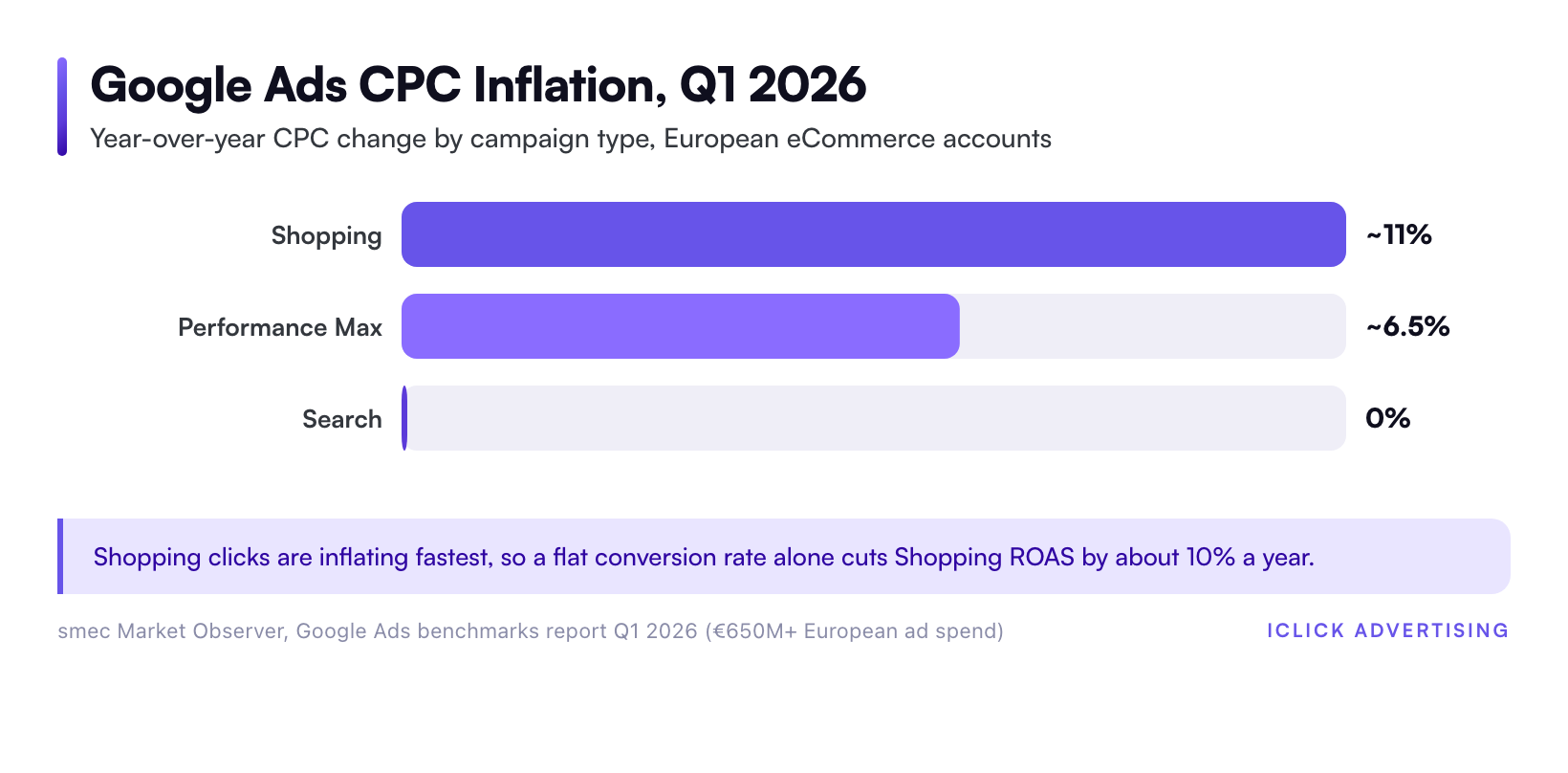
That data is European, but North American DTC brands face the same pressure. If your Shopping CPCs rise 11% and conversion rate stays flat, ROAS falls about 10% before you touch anything. Scaling on top of that needs a plan, not hope.
Step 1: Set Your ROAS Target From Margin, Not From Last Month
The most common scaling mistake is treating last month’s ROAS as the floor. That number came from a smaller, easier budget. Holding it fixed while spend doubles guarantees you stall.
Start with break-even ROAS instead. Divide 1 by your contribution margin after cost of goods, shipping, payment fees, and returns. A brand with a 40% contribution margin breaks even at 2.5x. Anything above that is profit on the first order.
Run your own numbers in our Google Ads ROAS calculator before you set a single target. Then compare them to category norms in our guide to good ROAS for eCommerce by category, margin, and channel.
For reference, here is what well-optimized accounts deliver in iClick’s own portfolio, from our 2026 PPC benchmarks. These figures come from accounts we manage, not industry surveys.
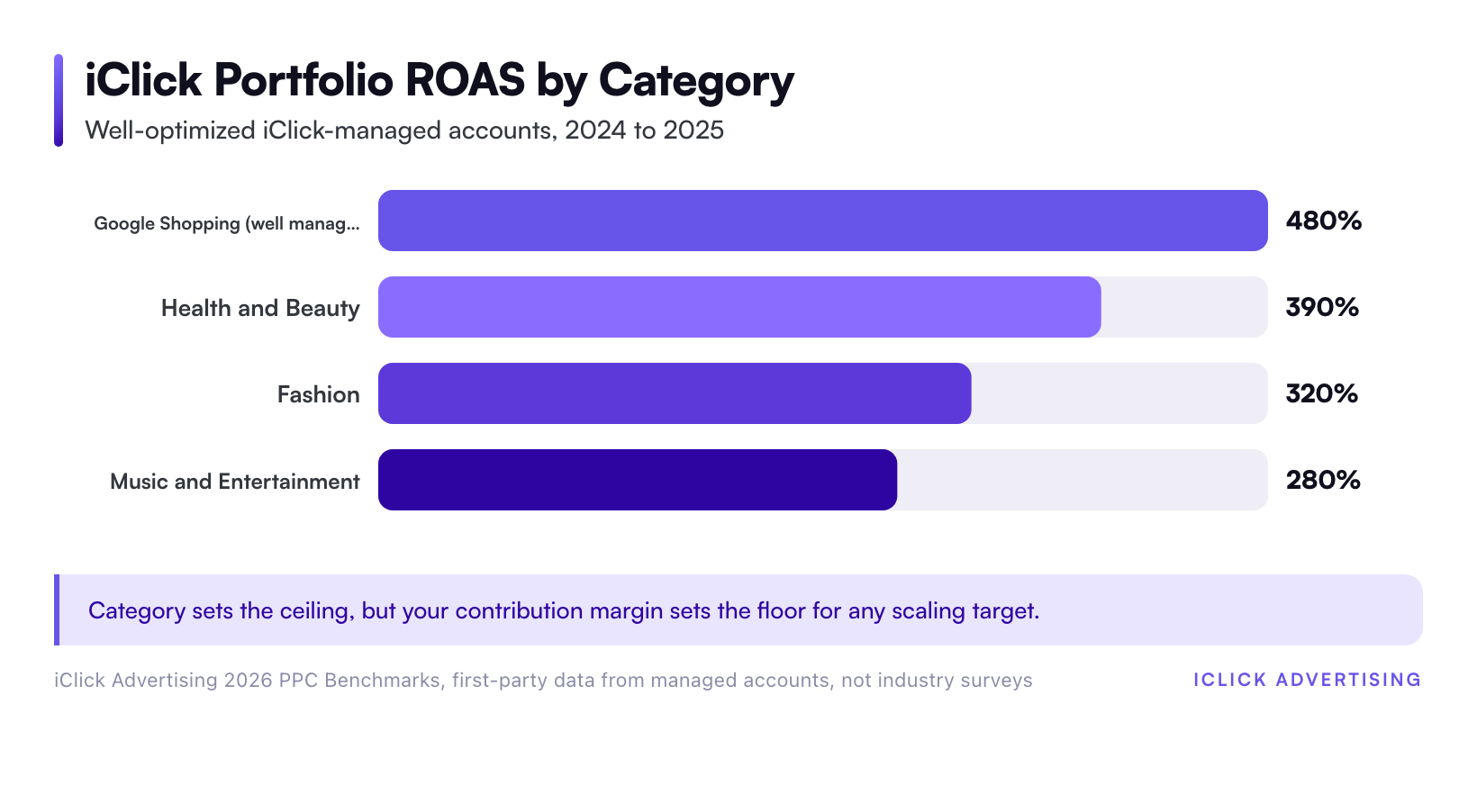
- Google Shopping (well managed): 480% ROAS
- eCommerce, Health and Beauty: 390% ROAS
- eCommerce, Fashion: 320% ROAS
- Music and Entertainment merch: 280% ROAS
Your scaling target should sit between break-even and your current average. That gap is the room you have to buy new customers.
Repeat purchase data lets you go further. A brand with strong repeat orders can accept a first-order ROAS below break-even, as long as 90-day revenue per customer covers it. Only do this with real cohort data from Shopify or your analytics, never a guess.
Step 2: Give Every Campaign One Job Before Adding Budget
If you add budget to a messy structure, the money flows to whatever the algorithm finds easiest. Usually that is brand traffic you would have won anyway.
Split the account by job before you scale:
- Brand search: cheap defense. Cap it so it cannot soak up new budget.
- Non-brand search: category terms that bring new customers. Most scaling budget belongs here.
- Shopping or Performance Max: product discovery, segmented by margin tier and bestseller status.
- Prospecting on Meta or YouTube: demand creation, judged on new-customer cost, not last-click ROAS.
Watch the overlap between Shopping and Performance Max closely. iClick’s benchmark data shows PMax cannibalizes Shopping in 80%+ of accounts. Google’s help center confirms that Search campaigns with an exact match keyword take priority over Performance Max when a query matches that keyword. Use that rule to protect your best terms.
We cover the full decision in Google Shopping vs Performance Max: which should run your product ads. For how we lay out whole accounts, read inside the eCommerce PPC playbook and how we structure $61M of ad spend.
Step 3: Raise Budgets in Steps the Algorithm Can Absorb
Doubling a budget overnight is the fastest way to crash ROAS. The bidder suddenly has to find twice the conversions in auctions it has never tested.
Know How Google Actually Spends Your Budget
Google’s documentation on overdelivery is clear. A campaign may spend up to twice its average daily budget on a given day. Over a month, it will spend no more than 30.4 times that daily budget.
That matters when you plan steps. A $2,000 daily budget can spend $4,000 on a strong Tuesday. Judge spend weekly, not daily, or you will overreact to normal swings.
Use a Step Ladder, Not a Leap
Raise budgets on your winning campaigns by 15% to 20% at a time. Then hold for at least two conversion cycles before the next step. Here is what that looks like for a brand at $50K a month:
- Weeks one and two: $50K to $58K pace. Watch marginal ROAS on the new spend.
- Weeks three and four: $58K to $67K pace, if new spend stays above break-even.
- Weeks five and six: $67K to $77K pace, with fresh creative and feed updates ready.
- Weeks seven and eight: Hold. Let the account stabilize and read the blended numbers.
That is a 54% increase in two months without a single leap large enough to wreck the bidder.
Loosen the Target, Don’t Just Raise the Budget
If a campaign is capped by its target ROAS, more budget will not spend. Google’s target ROAS guidance says a target set too high may limit the traffic your ads get. It recommends lowering the target gradually to enter more auctions.
Pair budget steps with small target drops, such as 450% to 420%. Never cut the target below your break-even ROAS from Step 1.
Roll Back One Step When a Step Fails
Sometimes marginal ROAS on the new spend stays below break-even for two full conversion cycles. When that happens, return to the previous budget level. Don’t cut deeper than that.
Then find the cause before trying again. It is usually a weak product set, a stale ad, or a target set too tight. Most failed steps trace back to inputs, which is the next step.
Step 4: Feed the Machine Better Inputs
At $50K a month, bidding tweaks matter less than what the algorithm is working with. Three inputs decide how far you can scale.
Product Feed Quality
Shopping and PMax can only bid on products Google approves. In iClick’s benchmark data, unmanaged accounts show a 12% feed disapproval rate. That means 12% of the catalog sits out of every auction while you pay more for the rest.
Fix titles, GTINs, and product types first. Then add custom labels for margin and bestseller status. That lets you push budget to products that can afford it.
Conversion Values That Reflect Profit
If you pass gross revenue, the algorithm treats a $200 order at 20% margin the same as one at 60%. Pass profit-adjusted values where you can. At minimum, exclude shipping and tax, and account for high-return categories.
Creative Volume
Creative wears out faster at higher spend. In iClick’s portfolio, Meta CPMs rose 38% year over year to $11.54, and CTR is declining from creative fatigue. More spend on the same five ads just shows them to the same people more often.
Plan a refresh cadence before you scale, not after performance drops.
Step 5: Add Channels Only When the Core Is Saturated
Adding channels too early spreads a small budget thin. Adding them too late leaves you paying rising CPCs for shrinking returns on Google.
The signal is marginal ROAS. When each new step on Google returns less than your target, it is time to open a new channel. Common next steps for DTC brands are Meta prospecting, YouTube, and Amazon.
We Love Eyes, an eye care brand selling DTC and on Amazon, is a good example. iClick’s work there produced a 10x ROAS, 340% more Amazon orders, and a 28% drop in blended CAC. Amazon became a second growth engine next to the DTC store, and blended acquisition cost fell rather than rose.
Step 6: Judge the Scale on Blended Numbers
Platform ROAS will fall as you scale. That is expected, because each platform claims credit for sales that other channels helped create. Once you run three or more channels, the platforms together will often claim more revenue than you actually made.
Track blended ROAS instead. Divide total store revenue by total ad spend across every channel. Track new-customer CAC next to it. If blended ROAS holds while new customers grow, your scale is working, even if Google Ads shows a lower number.
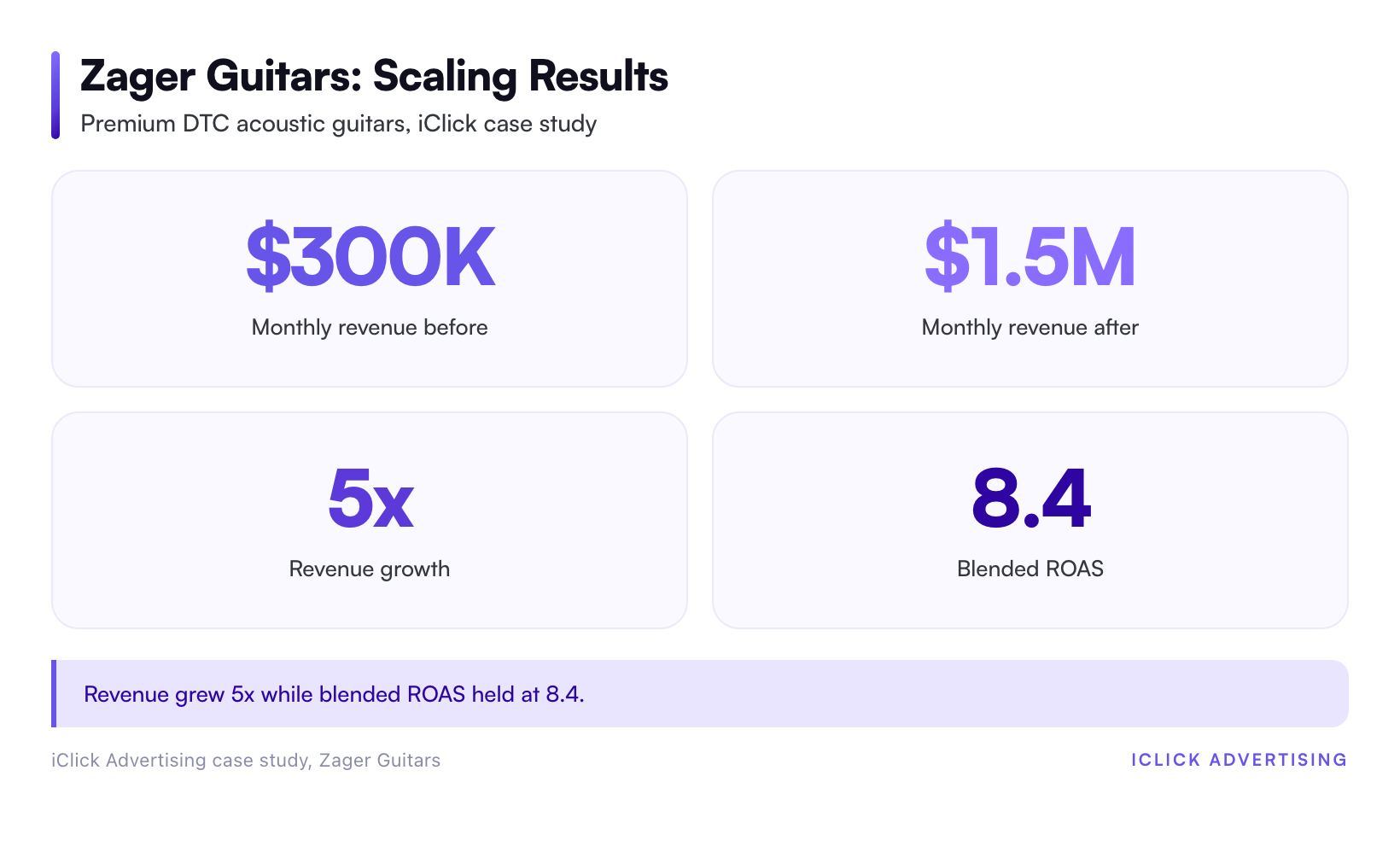
Zager Guitars shows what that looks like at scale. The account grew from $300K to $1.5M in monthly revenue, a 5x increase, while holding an 8.4 blended ROAS.
What Scaling Looks Like in Real DTC Accounts
The steps above are not theory. Here are three iClick case studies, each at a different spend level.
Zager Guitars: Scaling a Premium Product
Zager sells high-ticket acoustic guitars online. Revenue went from $300K to $1.5M a month at an 8.4 blended ROAS. Premium products like this can scale hard, because a high order value gives the bidder more room per click.
Wish Rock Relaxation: High Spend, High Ticket
Wish Rock sells massage chairs, a big-ticket and long-consideration purchase. The account runs at $80K+ a month in spend with a 10x ROAS. Conversion rate rose 62%. A higher conversion rate is what lets a bidder hold ROAS while spend climbs.
Splendid Iris: Building Toward Scale
Fine jewelry brand Splendid Iris started on a $20K monthly budget. It reached a 6.2x ROAS and profitable scale in three months. That is the foundation you want in place before you push toward $50K.
See more DTC, Shopify, and health and wellness results on our eCommerce PPC services page, or browse the full set of iClick case studies.
Your 90-Day Scaling Checklist
Use this before you add your next $10K a month:
- Calculate break-even ROAS from contribution margin, not gross margin.
- Split brand, non-brand, Shopping or PMax, and prospecting into separate budgets.
- Add exact match Search coverage for your top non-brand terms.
- Fix feed disapprovals and add margin-tier custom labels.
- Switch conversion values to profit-adjusted where possible.
- Raise budgets 15% to 20% at a time, holding for two conversion cycles.
- Lower target ROAS in small steps, never below break-even.
- Load a creative refresh queue before each budget step.
- Report blended ROAS and new-customer CAC weekly.
For the complete framework, from account structure to measurement, read our eCommerce PPC playbook.
Find Out What’s Capping Your Account
Every DTC account that stalls past $50K a month has a specific ceiling. It might be feed disapprovals, PMax eating your Shopping campaigns, or a ROAS target set from last year’s margin. The fix depends on which one you have.
Our free written audit checks 47 points across your account. You get a PDF in five business days, with no sales call. Request your free written PPC audit and find out what is holding your scale back.
Related on iClick
Sources
- Google Ads Help, About overdelivery and your average daily budget (2x daily, 30.4x monthly), accessed September 2026
- Google Ads Help, About Target ROAS bidding (high targets limit traffic; one to two conversion cycles after target changes), accessed September 2026
- Google Ads Help, Duration of the learning period for campaigns and what affects it, accessed September 2026
- Google Ads Help, About Performance Max campaigns (exact match Search priority over PMax), accessed September 2026
- smec Market Observer, Google Ads benchmarks report, Q1 2026 (CPC inflation by campaign type, €650M+ European spend)
- iClick Advertising, 2026 PPC Benchmarks (first-party data from iClick-managed accounts, 2024 to 2025)
- iClick Advertising, Case Studies (Zager Guitars, Wish Rock Relaxation, We Love Eyes, Splendid Iris)
Frequently asked questions
How fast can I increase my Google Ads budget without hurting ROAS?
Raise budgets on winning campaigns by 15% to 20% at a time, then hold for at least two conversion cycles. Google says a changed target ROAS needs one to two conversion cycles to settle. If customers take four days to buy, wait about eight days between steps. Judge spend weekly, since Google can spend up to twice your daily budget on any given day.
What ROAS should a DTC brand target when scaling?
Target a number between your break-even ROAS and your current average. Break-even ROAS is 1 divided by contribution margin, so a 40% margin breaks even at 2.5x. In iClick’s managed portfolio, well-run Shopping accounts reach 480% ROAS, Health and Beauty 390%, and Fashion 320%. Your margin, not a benchmark, sets the floor.
Why does ROAS drop when I increase ad spend?
Your first dollars buy the cheapest, highest-intent clicks, like branded searches and returning visitors. Extra budget goes into auctions that convert worse, so marginal ROAS falls faster than average ROAS. Costs also rise on their own. The smec Q1 2026 report found Shopping CPCs up about 11% year over year in Europe.
Should I measure scaling success with platform ROAS or blended ROAS?
Use blended ROAS: total store revenue divided by total ad spend across all channels. Each platform claims credit for sales other channels helped create, so platform ROAS falls as you add channels. Track new-customer CAC next to blended ROAS. If both hold while revenue grows, your scale is working.
When should a DTC brand add Meta, YouTube, or Amazon?
Add a channel when each new budget step on Google returns less than your target ROAS. Adding channels too early spreads budget thin. We Love Eyes sells DTC and on Amazon. iClick’s work there produced 340% more Amazon orders, a 10x ROAS, and a 28% drop in blended CAC.