

TL;DR: Google Shopping should get most DTC brands’ first dollar. There’s no commission, you own the customer, and well-managed iClick Shopping accounts average 480% ROAS. Amazon charges a 15% referral fee in most categories before ad spend. Add it second, once your reviews, pricing, and margin can absorb that fee stack.
Amazon Ads vs Google Shopping: The Short Answer
Both channels sell products off a search query. The real difference is who owns the sale.
On Amazon, the customer buys from Amazon. You pay for the click, then pay a referral fee on the order. Amazon keeps the customer relationship.
On Google Shopping, the click lands on your own store. You pay for the click, and the margin, the email address, and the repeat purchase are yours.
That one difference drives most of the decision. For a DTC brand with healthy margins and a site that converts, Google Shopping usually earns the first dollar. Amazon becomes the second channel once the product can win on Amazon’s terms: price, reviews, and Prime shipping.
We manage both channels for eCommerce brands, from premium guitars to eye care. Here is how we make the call, with the math shown.
Amazon Ads vs Google Shopping at a Glance
| Factor | Amazon Ads | Google Shopping |
|---|---|---|
| Where the sale happens | On Amazon’s marketplace | On your own store |
| Pricing model | CPC auction (Sponsored Products, Sponsored Brands, Sponsored Display) | CPC auction (Standard Shopping or Performance Max) |
| Fees on each sale | 15% referral fee in most categories, plus fulfillment if you use FBA | No commission from Google |
| Customer data | Amazon owns it | You own it: email, pixel, and lifetime value |
| What drives placement | Bid, relevance, sales history, reviews, and Buy Box status | Bid, feed quality, price competitiveness, and site experience |
| Best fit | Replenishable, review-rich, price-competitive products | Brands with margin, a converting site, and repeat-purchase potential |
| Biggest risk | Fee stacking erodes margin; limited brand control | Feed disapprovals; Performance Max cannibalizing Shopping |
The table hides one thing: the two channels rarely compete for the same shopper at the same moment. Someone searching Amazon has usually decided to buy on Amazon. Someone searching Google is still comparing stores.
How the Money Actually Works
Most comparisons stop at CPC. That misses the bigger cost. On Amazon, the click is only the first fee.
Amazon’s fee stack
Amazon charges a 15% referral fee in most product categories, according to its published seller pricing page. The Professional selling plan adds $39.99 a month. Both sit on top of your ad spend.
Here is a simple illustration. Take a $60 product that costs $18 to make. Assume $8 to fulfill and ship it on either channel.
- Amazon: $60 minus $18 product cost, $9 referral fee, and $8 fulfillment leaves $25. Your break-even ACoS is about 42%.
- Your own store via Google Shopping: $60 minus $18 and $8 leaves $34. Your ad cost can reach about 57% of revenue before you lose money. That is a break-even ROAS of roughly 1.8x.
Same product, same shipping cost. Amazon leaves you 15 fewer points of room for advertising on every order.
Low-priced products feel this most. Fulfillment is a fixed cost per unit, so a $20 item loses a far bigger share of its price than a $60 one. Premium products handle the fees better, but they also have the most margin to give away.
Google Shopping’s cost structure
Google takes no cut of the sale. You pay for clicks and your normal payment processing. That’s it.
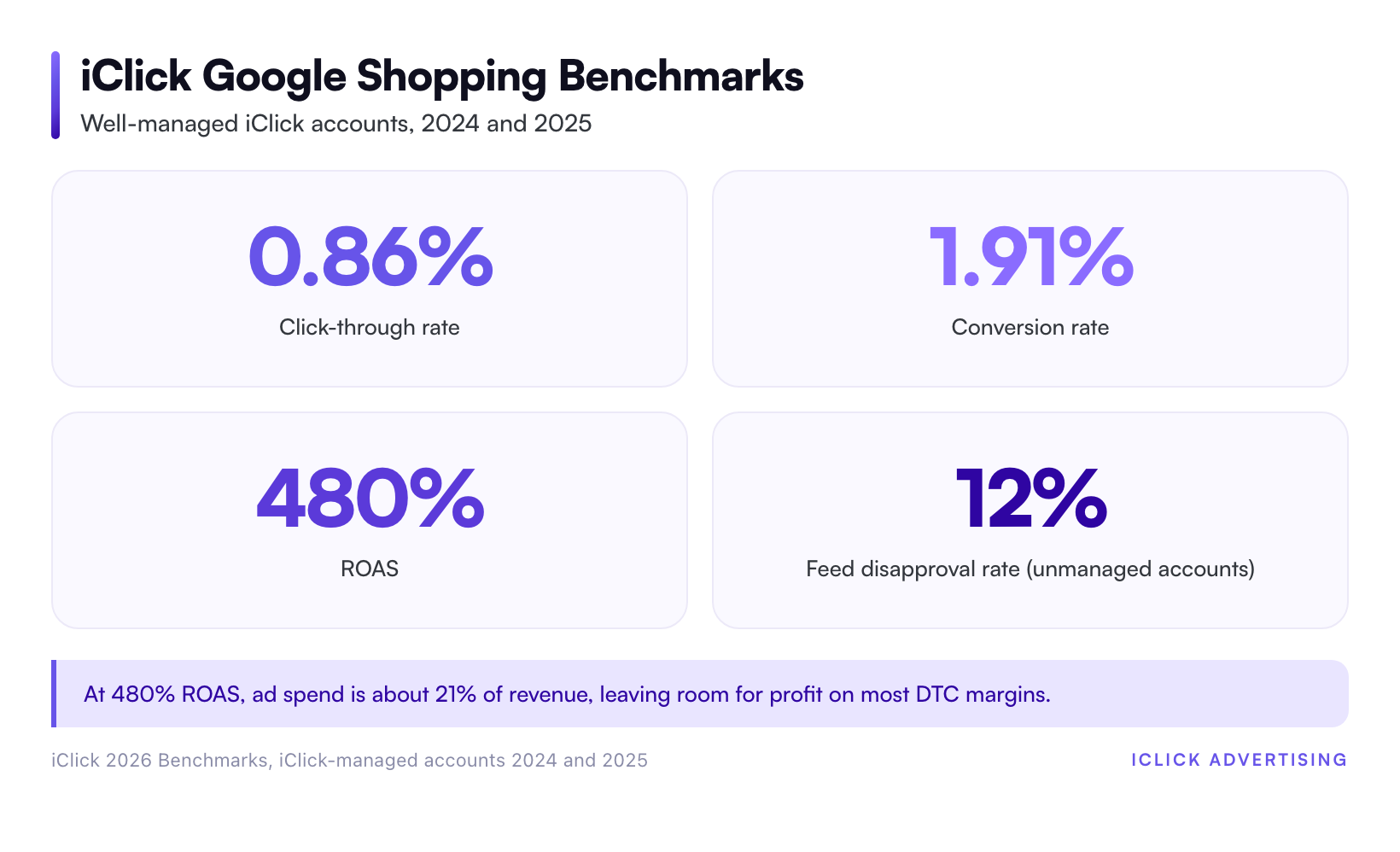
The question is whether those clicks convert. In iClick-managed accounts across 2024 and 2025, well-run Google Shopping campaigns averaged a 0.86% CTR, a 1.91% conversion rate, and 480% ROAS. Those are our own portfolio numbers from our 2026 benchmarks page, not industry averages.
At 480% ROAS, ad spend is about 21% of revenue. In the example above, that sits far below the 57% ceiling. There is room left for profit and for testing new products.
What the customer is worth after the first order
This is where Google Shopping pulls ahead for DTC brands. A shopper who buys on your site joins your email list. You can retarget them, cross-sell them, and measure their lifetime value.
A shopper who buys on Amazon is Amazon’s customer. The second order often starts with another paid click. For brands with strong repeat purchase rates, that gap compounds every month.
Scale: Where the Shoppers Are
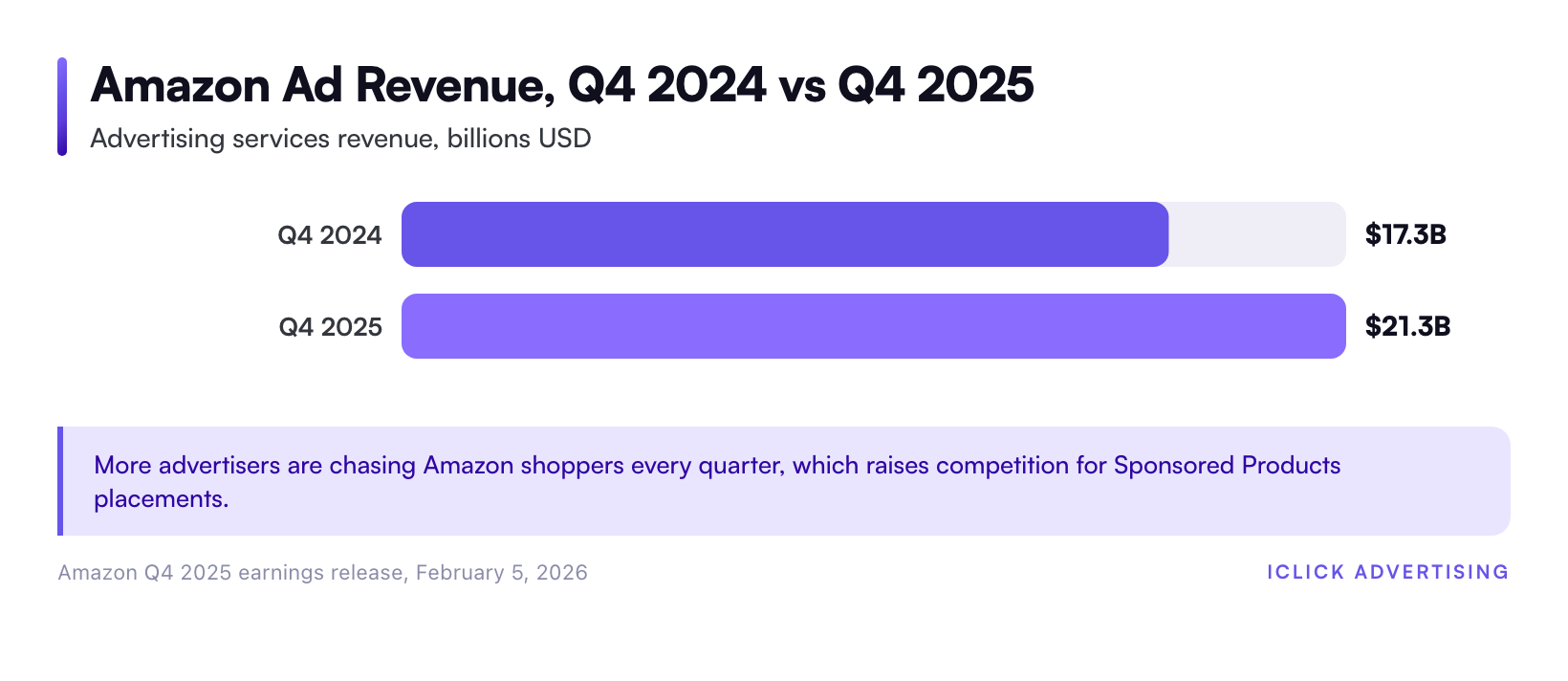
Neither channel is small. Amazon reported $21.3 billion in advertising services revenue for Q4 2025, up from $17.3 billion in Q4 2024, in its February 5, 2026 earnings release. That money follows buyers who already have their wallets out.
Google’s reach is broader. Google said in May 2025 that its Shopping Graph holds more than 50 billion product listings, with over 2 billion refreshed every hour. Your Shopping ad appears next to Walmart, Target, and often Amazon itself.
In practice, a Google shopper can compare your price with a dozen stores in one scroll. Your image, price, and review stars do the selling before anyone clicks.
Both numbers point to the same thing: competition. The bar for feed quality on Google and review count on Amazon keeps rising.
When Google Shopping Should Get the First Dollar
Start with Google Shopping when most of these are true.
Your margin is above 50%
Premium DTC products usually carry margins that make a 15% commission painful. Google Shopping lets you spend that 15% on ads instead.
Your site already converts
Google sends traffic to your store, so your store has to close. If your checkout converts poorly, fix that first. No bid strategy saves a broken product page.
Customers buy more than once
Consumables, accessories, and collections reward owning the customer. Every repeat order through email costs far less than a new paid click.
Your catalog is deep
Shopping campaigns scale well across hundreds of SKUs when the feed is clean. Zager Guitars grew from $300K to $1.5M a month in revenue with an 8.4 blended ROAS on a Google-led program.
Two warnings before you launch. First, feed health matters more than bids. Our benchmarks put the feed disapproval rate in unmanaged accounts at 12%. Second, watch Performance Max. On our benchmarks page, we note that PMax cannibalizes Shopping in 80%+ of accounts. If you are unsure which campaign type fits your catalog, our Google Ads campaign types decision tree walks through it. New to the auction itself? Start with how Google Ads works in plain English.
When Amazon Ads Should Get the First Dollar
Amazon goes first in a narrower set of cases.
Your category defaults to Amazon
For supplements, household goods, and replacement parts, many buyers skip Google entirely. If your competitors sell mainly on Amazon, your shoppers are there too.
You already have reviews and the Buy Box
Sponsored Products amplifies what already works. A listing with strong reviews, competitive pricing, and Prime eligibility converts ad clicks. A new listing with a few reviews usually burns budget.
Competitors are bidding on your brand
If rivals target your brand name on Amazon, you need Sponsored Brands to defend it. Letting them take that traffic hands your own demand to someone else.
Your price can absorb the fees
Run the fee math above with your real numbers. If break-even ACoS lands below 25%, Amazon advertising will be a constant fight for profit.
For a deeper look at Sponsored Products structure and retail readiness, see our Amazon Ads channel page.
Running Both: The We Love Eyes Pattern
Most DTC brands above a certain size should run both. The trick is measuring them together.
We Love Eyes, an eye care brand selling DTC and on Amazon, is the clearest example in our portfolio. The program reached 10x ROAS, grew Amazon orders by 340%, and cut blended CAC by 28%.
The lesson is the word blended. Some shoppers see your Google Shopping or YouTube ad, then search your brand on Amazon to buy with Prime. Channel-level reports miss that path. Blended CAC catches it.
Upper-funnel video feeds both channels. Our guide to YouTube ads for eCommerce creative frameworks covers the formats that drive that branded search.
A practical rollout order
- Build the Google Shopping base. Clean the feed, separate Standard Shopping from Performance Max, and get ROAS stable.
- Launch Amazon on proven SKUs. Pick the products with the best reviews and margin. Start with Sponsored Products on exact-match terms.
- Add brand defense. Run Sponsored Brands on your own brand name once competitors appear.
- Judge on blended numbers. Track total revenue against total ad spend across both channels, not each dashboard in isolation.
Budget splits depend on where your sales already happen. Let each channel earn more budget by beating your blended target, not by winning its own dashboard.
Mistakes We See in Audits
- Judging Amazon on ACoS alone. ACoS ignores organic sales that ads help drive. Look at total ad spend against total Amazon revenue too.
- Letting Performance Max absorb Shopping. PMax often claims branded and remarketing sales that would have happened anyway.
- Ignoring feed disapprovals. Disapproved products simply don’t serve. Check Merchant Center diagnostics weekly.
- Pricing the same everywhere without doing the math. A price that works on your site may lose money on Amazon after fees.
- Skipping Brand Registry. Without it, you lose access to Sponsored Brands and control over your listings.
The Verdict for DTC Brands
If you sell a premium product with healthy margins and a site that converts, fund Google Shopping first. You keep the full sale, own the customer, and build a list you can sell to again.
Add Amazon when your top products have reviews, competitive pricing, and enough margin to survive a 15% referral fee plus ad costs. Then manage both channels against one blended CAC target.
If your category lives on Amazon, flip the order. Just run the fee math first so you know your real break-even ACoS before you spend.
You can compare every channel we run on our paid media channels hub.
Not Sure Your Split Is Right?
Most brands we audit are overspending on one channel and underfunding the other. The fix is usually visible in the numbers within a week.
Our free written PPC audit is a 47-point PDF covering your Google Shopping feed, campaign structure, and cross-channel efficiency. You get it in five business days, with no sales call. Request your free audit.
Sources
- Amazon.com Announces Fourth Quarter Results (Amazon, February 5, 2026)
- How much does it cost to sell on Amazon? (Amazon seller pricing, accessed September 2026)
- Shopping on Google: AI Mode and virtual try-on updates from I/O 2025 (Google, May 20, 2025)
- iClick 2026 PPC Benchmarks (iClick-managed accounts, 2024 and 2025)
- iClick case studies: We Love Eyes and Zager Guitars
Frequently asked questions
Is Amazon Ads or Google Shopping cheaper for a DTC brand?
Google Shopping is usually cheaper per order once you count fees. Amazon charges a 15% referral fee in most categories on top of your ad spend. Google takes no commission. A $60 Amazon sale hands $9 to Amazon before you pay for the click or fulfillment. That gap shrinks your room for advertising on every order.
What ROAS should I expect from Google Shopping?
It depends on margin, price, and feed quality. In iClick-managed accounts across 2024 and 2025, well-run Google Shopping campaigns averaged 480% ROAS, with a 0.86% CTR and a 1.91% conversion rate. Treat those as a target for a well-optimized account, not a guarantee. Calculate your own break-even ROAS from your margin first.
Should a DTC brand sell on Amazon at all?
Often yes, once the basics work. Amazon reaches shoppers who never search Google for your category. The best time to add it is when your top products have strong reviews, competitive pricing, and enough margin to absorb the fee stack. We Love Eyes grew Amazon orders by 340% while cutting blended CAC by 28%.
Does Performance Max replace Google Shopping campaigns?
No. Performance Max can serve Shopping placements, but it often claims branded and remarketing sales that would have happened anyway. On our benchmarks page, we note that PMax cannibalizes Shopping in 80%+ of accounts. Running Standard Shopping alongside PMax, with clear product separation, gives you cleaner data and more control over spend.