
TL;DR: Put most of your search budget on non-branded keywords, because they create new customers. Fund branded keywords only up to their demand ceiling. Google’s pause-study data shows just 50% of ad clicks are incremental when you already rank first organically. But if competitors bid on your name and you don’t, they can take 18% to 42% of clicks.
Branded vs Non-Branded Keywords: The Short Comparison
Branded keywords contain your company or product name. Think “Zager guitars,” “Shopify login,” or “Morgan and Morgan phone number.” The searcher already knows you.
Non-branded keywords describe the problem or the category. Think “acoustic guitar for beginners,” “eCommerce platform for small business,” or “truck accident lawyer.” The searcher is still choosing.
That difference drives everything else: cost, conversion rate, incrementality, and how you judge results.
| Factor | Branded keywords | Non-branded keywords |
|---|---|---|
| Searcher intent | Navigational. They want you. | Commercial or exploratory. They want a solution. |
| Typical CPC | Low, because your Quality Score is high and few rivals bid | Market rate, often several times higher |
| Conversion rate | Very high | Lower, varies by match type and offer |
| Incrementality | Low to moderate. Many clicks would arrive through organic anyway | High. Most clicks are new demand |
| Main job | Defend the top slot, control the message, absorb competitor pressure | Win new customers and grow revenue |
| Main risk | Inflated ROAS that hides weak prospecting | Budget burn on loose match types and poor queries |
| How to measure | Pause or holdout tests, impression share, Auction Insights | CPA or ROAS against target, new customer rate |
The verdict: non-branded campaigns should carry most of your budget and all of your growth targets. Branded campaigns are insurance. They are cheap, but they should never be the reason your blended ROAS looks good.
Why Branded Search Looks Better Than It Is
Branded campaigns almost always post the best numbers in the account. The click is cheap, the searcher is ready, and the conversion rate is high. That is exactly the problem.
A strong brand ROAS does not prove the ad caused the sale. It proves the searcher already wanted you. The real question is incrementality: how many of those sales would have happened anyway through your organic listing?
What the research says about brand incrementality
The most cited experiment comes from eBay. In a 2015 paper in Econometrica, economists Thomas Blake, Chris Nosko, and Steven Tadelis reported what happened when eBay paused brand keyword ads on Yahoo and Microsoft. Traffic shifted almost entirely to organic results. The authors concluded brand keyword ads had no measurable short-term benefit for eBay.
Read the fine print before you pause anything. eBay is one of the best-known brands online, and few rivals were fighting for its name. Most advertisers do not have that luxury.
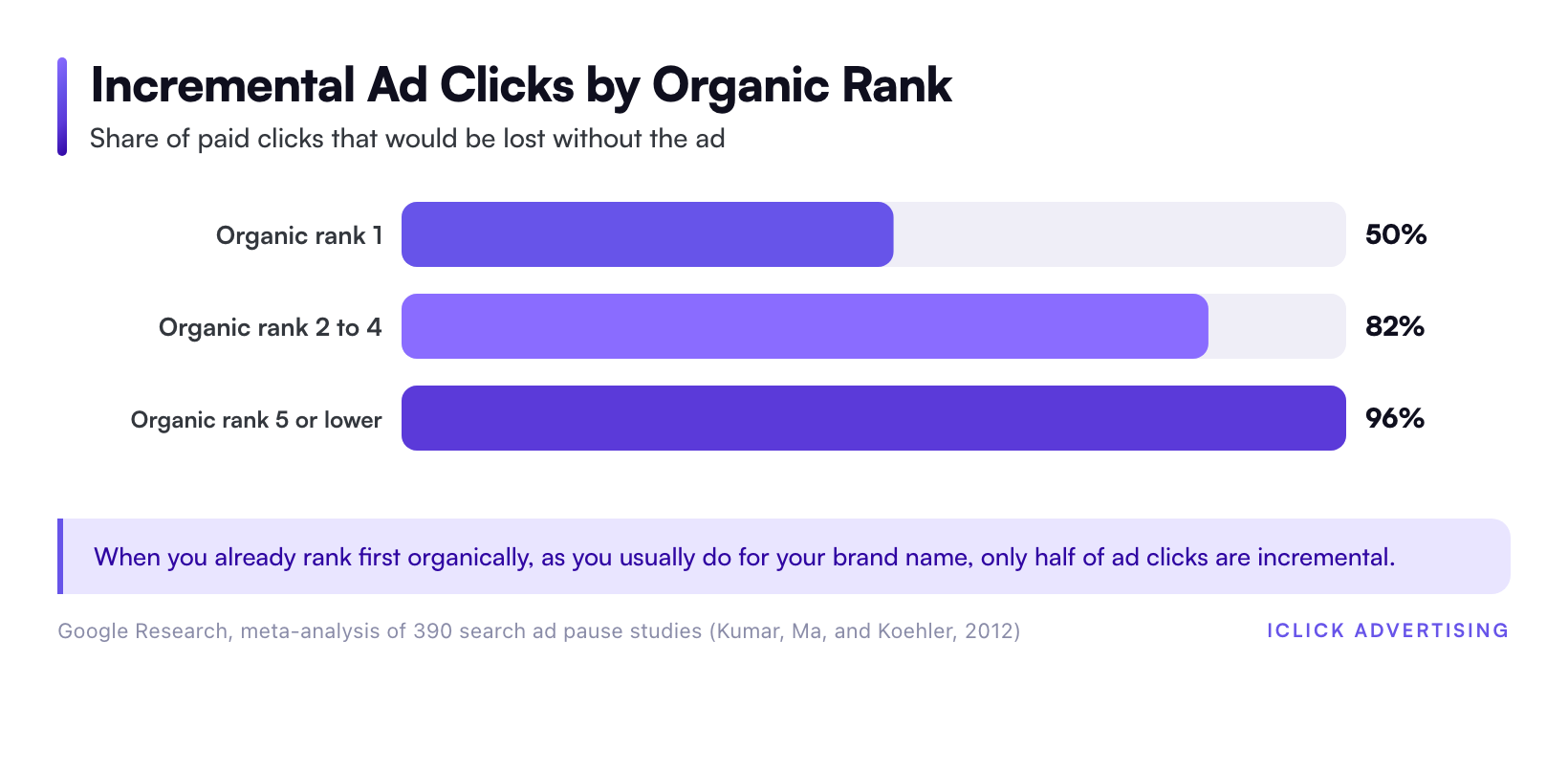
Google’s own research points the same way, with nuance. A 2012 Google meta-analysis of 390 search ad pause studies found only 50% of ad clicks were incremental when the advertiser already held the number one organic position. When the organic listing ranked in positions 2 to 4, incrementality rose to 82%. Below position 4, it reached 96%.
On branded queries, you usually rank first organically. So the 50% figure is the closest proxy for your brand campaign. Up to half your brand clicks may be traffic you would have earned for free.
Compare that with Google’s broader 2011 finding. Across more than 400 pause tests, an average of 89% of paid clicks were lost, not recovered by organic, when campaigns were paused. That average is driven by queries where advertisers do not own the top organic spot, which describes most non-branded search.
Competition changes the math
The eBay result describes a brand with little bidding pressure. That is not most markets.
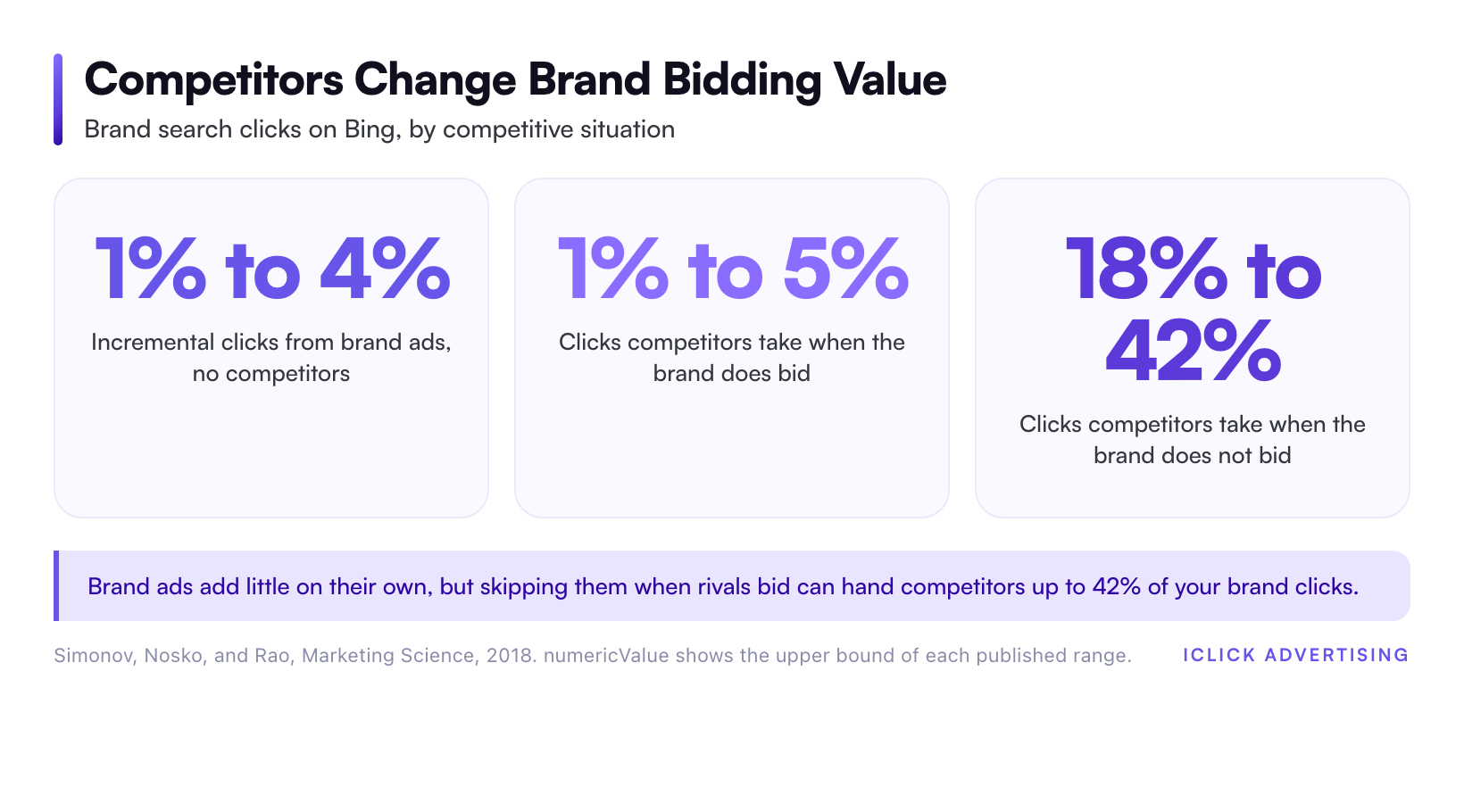
A 2018 study in Marketing Science by Andrey Simonov, Chris Nosko, and Justin Rao measured brand searches on Bing. With no competitors in the auction, brand ads added only 1% to 4% in incremental clicks. Larger brands saw the smallest effect.
The picture flipped when competitors showed up. When a brand skipped its own name and rivals bid on it, competitors took 18% to 42% of the clicks. When the brand did bid, its ad held the top slot and limited rivals to 1% to 5% of clicks. The authors found the return on that defensive spend was strongly positive.
So the honest answer to “should I bid on my brand?” is: it depends on who else is in the auction.
When Bidding on Branded Keywords Makes Sense
Use these triggers as a checklist, not a blanket rule.
- Competitors bid on your name. Check Auction Insights on your brand campaign. If rivals show meaningful impression share, defend the slot. The 18% to 42% click loss in the Simonov study is the cost of staying silent.
- Resellers, affiliates, or marketplaces outrank you. Amazon sellers, review sites, and affiliate partners often bid on brand terms. If they take the top ad slot, they take your margin too.
- Your organic listing is weak. A new brand, a recent rebrand, or a name shared with another company may not rank first. Google’s data shows incrementality climbs fast below organic position 1.
- You need message control. Sales, launches, and limited stock are hard to communicate through a meta description. A brand ad puts the offer, price, and sitelinks above the fold.
- Your brand queries carry comparison words. Searches like “brand reviews,” “brand pricing,” or “brand vs competitor” come from people still deciding. Treat them closer to non-branded intent.
When you can safely cut brand spend
- You hold organic position 1 for your name, with sitelinks.
- Auction Insights shows little or no competitor overlap on brand terms.
- A controlled pause test shows total brand conversions (paid plus organic) stay flat.
- The savings would fund meaningful non-branded testing.
If all four are true, drop brand to a minimal defensive budget rather than zero. That keeps you in the auction if a competitor starts bidding later.
How to Split Budget Between Branded and Non-Branded
There is no universal ratio. The right split depends on brand demand, competitor pressure, and your growth goal. But you can set it with a repeatable process.
Step 1: Fund brand to its demand ceiling, not a percentage
Brand search volume is finite. A bigger budget cannot buy more people searching your name. So set the brand budget to cover roughly 90% or more impression share on core brand terms, then stop.
Any dollar above that ceiling buys nothing. For an established brand with steady search volume, the capped figure usually lands well below the non-branded budget.
Step 2: Send everything else to non-branded
Non-branded search is where new customers come from. Split it by intent: high-intent category terms first, then problem terms, then broader research terms. For a refresher on how the auction prices each of those clicks, our plain-English guide to how Google Ads works covers Ad Rank and Quality Score.
For pricing context, non-brand clicks usually cost several times what brand clicks do, and competitive verticals such as personal injury and B2B SaaS sit at the top of the range.
Step 3: Report them as two separate programs
Never set one blended ROAS or CPA target across both. A brand campaign with an outsized ROAS can hide a non-branded program that loses money on every sale.
Give each its own target. Brand gets an impression share goal and a CPC ceiling. Non-branded gets a CPA or ROAS goal tied to new customer value.
Competitor Conquesting: Defense and Offense
Conquesting means bidding on a competitor’s brand name. Google’s trademark policy restricts trademarked terms in ad text, but it does not block them as keywords.
That means rivals can bid on your name today. It also means you can bid on theirs.
Playing defense
Review Auction Insights on your brand campaign weekly. Track overlap rate and position-above rate for each rival. A sudden jump usually means a competitor launched a conquesting campaign.
Your response is usually cheap. Your Quality Score on your own name is far higher than theirs, so you can hold the top slot at a fraction of their CPC.
Playing offense
Conquesting campaigns tend to post low click-through and conversion rates, because the searcher wanted someone else. Quality Scores are poor, so CPCs run high.
Conquesting works best when you have a provable advantage: lower price, faster shipping, or a feature the rival lacks. Write the ad around that difference. Keep the competitor’s trademark out of your ad copy.
Secondary engines are a cheaper place to test. Microsoft Advertising auctions are usually less crowded. Our Microsoft Advertising channel guide covers importing and adjusting Google campaigns there.
Performance Max, Broad Match, and Hidden Brand Spend
The biggest leak in modern accounts is brand traffic you did not mean to buy. Performance Max and broad match both pick up branded queries by default.
The result is cannibalization. PMax claims easy brand conversions, its reported ROAS looks great, and budget drifts away from real prospecting.
Google now offers two controls. Brand inclusions restrict broad match Search campaigns to queries containing the brands you choose. Brand exclusions keep Performance Max and other Search campaigns off branded queries on Search and Shopping inventory. Our brand exclusions glossary entry explains the setting itself.
If PMax is already eating your brand traffic, follow the step-by-step workflow to fix PMax brand cannibalization. It covers exclusion lists, search term insights, and reading before-and-after numbers.
Where branded and non-branded traffic should live also depends on structure. Our decision tree for Google Ads campaign types shows when Search, Shopping, PMax, and Demand Gen fit.
How to Measure Brand Bidding Incrementality
Platform-reported conversions cannot tell you what is incremental. You need a test with a control. Here are three options, from simplest to strongest.
Option 1: Pause test
Pause brand ads for two to four weeks. Track total branded conversions from paid plus organic, not just paid. Compare against the prior period and the same period last year.
This mirrors Google’s own pause studies. It is easy to run but sensitive to seasonality, so avoid sale periods.
Option 2: Bid-down test
If pausing feels too risky, cut brand bids sharply and keep the campaign live. Watch whether competitors take the top slot and whether total conversions drop. The read is softer, but it often shows you are overpaying per brand click.
Option 3: Geo holdout
Turn off brand ads in a set of matched regions and keep them on everywhere else. Compare total branded conversions between the two groups. The authors of Google’s 2012 study recommended randomized experiments like geo tests for exactly this question.
Geo tests control for seasonality and news events. They need enough volume per region to produce a clear result.
Metrics to track during any test
- Total branded conversions (paid plus organic)
- Organic click-through rate on brand queries in Google Search Console
- Competitor impression share in Auction Insights
- New versus returning customer rate
- Blended cost per acquisition across all channels
Branded Search Beyond Google
Brand demand is created upstream. Video, social, and display campaigns send people to search your name later. When those channels work, branded search volume rises.
So never judge a YouTube campaign only by last-click conversions. Watch branded search volume as a secondary signal.
The same branded vs non-branded logic applies across our paid media channel guides. On Amazon, for example, competing sellers bid directly on your product names, so brand defense matters there too.
The Decision Framework in One View
- No competitors on your name, organic position 1: run a minimal brand budget and test a pause.
- Competitors bidding on your name: fund brand to 90%+ impression share and defend.
- New or weak brand presence: bid on brand fully until organic rank catches up.
- PMax or broad match active: apply brand exclusions and inclusions so brand spend stays visible.
- Every account: report brand and non-brand separately, and put growth targets on non-branded.
Find Out How Much of Your ROAS Is Brand
If your reports blend brand and non-brand, you cannot tell how much of your ROAS is traffic you would have earned anyway. That is the first thing worth fixing.
Request a free written PPC audit. You get a 47-point PDF review of your account within five business days, including how your budget splits across branded and non-branded search. No sales call required.
Sources
- Google Research: Impact of Ranking of Organic Search Results on the Incrementality of Search Ads (2012)
- Google Research Blog: Impact of Organic Ranking on Ad Click Incrementality (2012)
- Google Research Blog: Studies Show Search Ads Drive 89% Incremental Traffic (2011)
- Blake, Nosko, and Tadelis: Consumer Heterogeneity and Paid Search Effectiveness, Econometrica (2015), NBER working paper
- Simonov, Nosko, and Rao: Competition and Crowd-Out for Brand Keywords in Sponsored Search, Marketing Science (2018)
- Google Ads Help: About brand settings for Search and Performance Max
- Google Ads Policy Help: Trademarks
Frequently asked questions
What is the difference between branded and non-branded keywords?
Branded keywords include your company or product name, like “Zager guitars.” Non-branded keywords describe the category or problem, like “acoustic guitar for beginners.” Branded searchers already know you, so clicks are cheap and convert well. Non-branded searchers are still choosing, so those clicks cost more but bring in new customers who would not have found you otherwise.
Should I bid on my own brand name?
Bid on your brand if competitors, resellers, or affiliates bid on it, or if you do not rank first organically. A 2018 Marketing Science study found rivals took 18% to 42% of clicks when a brand did not defend its name. If nobody else bids and you hold organic position 1, test a pause before spending heavily.
What percentage of budget should go to branded keywords?
Do not set brand as a percentage. Fund it to cover roughly 90% or more impression share on core brand terms, then stop, because extra budget cannot create more brand searches. Everything else goes to non-branded campaigns. For most established brands, that cap leaves brand well below the non-branded budget.
How do I test whether brand bidding is incremental?
Run a pause test, a bid-down test, or a geo holdout. In each case, track total branded conversions from paid plus organic, not just paid. Watch competitor impression share in Auction Insights during the test. Geo holdouts are the strongest option because they control for seasonality, but they need enough volume per region.
Does Performance Max spend money on my brand terms?
Yes. By default, Performance Max can serve on branded queries and claim conversions you would likely get anyway. Google’s brand exclusions setting keeps PMax off branded queries on Search and Shopping inventory. Apply it, then compare PMax results before and after so you can see its true non-branded performance.