

TL;DR: Meta Andromeda is the retrieval engine that narrows tens of millions of eligible ads to a few thousand before ranking runs. Meta reports a 6% recall lift and an 8% ads quality lift on selected segments. The practical lesson: feed it genuinely different creative concepts and broader targeting, not near-copies of one ad.
What is Meta Andromeda?
Meta Andromeda is the ad retrieval engine behind Facebook and Instagram ads. Meta’s engineering team described it in a post dated December 2, 2024.
Retrieval is the first filter in ad delivery. Every time someone opens a feed, Meta has to decide which ads are even worth scoring. Andromeda narrows “tens of millions of ad candidates into a few thousand relevant ad candidates,” according to that post.
That sounds like plumbing. It is plumbing. But it is the step that decides whether your ad gets a chance at all.
Meta rebuilt that step around a hierarchical neural network. It runs on NVIDIA Grace Hopper hardware and Meta’s own MTIA chips.
Where retrieval sits in Meta’s ad delivery
Meta’s delivery system works like a funnel with three broad stages:
- Retrieval (Andromeda): picks a shortlist of a few thousand ads from the full eligible pool for one person, in one moment.
- Ranking: heavier models predict click, conversion, and value for each shortlisted ad.
- Auction: bid, predicted action rate, and ad quality combine to choose the winner.
Meta’s post notes that retrieval “processes three orders of magnitude more ads than subsequent stages.” In plain terms, retrieval sees roughly 1,000 times more ads than ranking does. So it has to be fast, and it has historically been the least personalized step.
Andromeda’s job is to make that first cut smarter. If a good ad never makes the shortlist, the ranking model never sees it. Your bid does not matter at that point.
What Meta says Andromeda changed
Meta’s December 2024 post gives specific numbers. All of them are Meta’s own reported results, not independent tests.
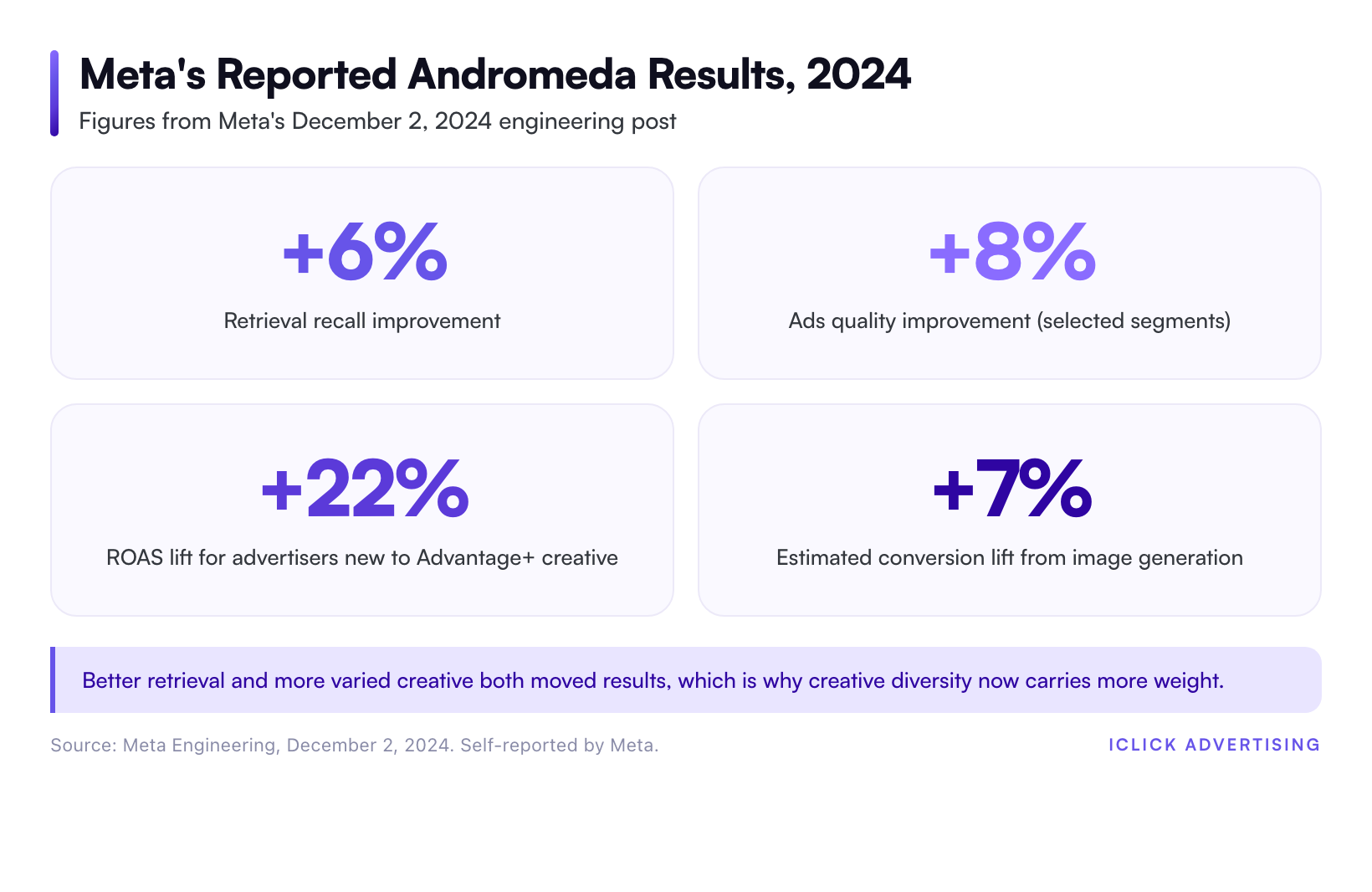
- +6% recall in the retrieval system, meaning more of the right ads make the shortlist.
- +8% ads quality on selected segments across Facebook and Instagram.
- 10,000x model capacity compared with the previous retrieval models, used for deeper personalization.
- 100x faster feature extraction, in both latency and throughput, versus the older CPU components.
- 3x more queries per second for end-to-end model inference.
The same post reports two creative results. Advertisers new to Advantage+ creative saw a 22% increase in ROAS after turning on its AI-driven features. Meta also estimates that businesses using image generation see a 7% increase in conversions.
The October 2026 update
Meta published a second Andromeda engineering post on October 28, 2026. It focuses on hardware and model co-design, but several numbers matter to advertisers.
| Measure | Andromeda, 2024 | Andromeda, 2026 |
|---|---|---|
| Throughput | Tens of millions of ads per second per GPU card | Over 1 billion ads per second in production (100x lift) |
| Compute per inference | Baseline | Roughly 300x fewer inference-time FLOPs |
| Reported advertiser result | +6% recall, +8% ads quality on selected segments | +2.4% conversions on Facebook since 2025 |
| Hardware | NVIDIA Grace Hopper and Meta MTIA | GH200 GPU with model and system co-design |
Meta does not publish its methodology for the 2.4% figure. Treat it as directional. Still, 2.4% across Facebook’s ad volume is a large absolute number.
The 2026 post also explains why scale matters so much. It says generative AI tools helped advertisers create “hundreds of millions of new ads,” and that pool keeps growing. Retrieval has to sort through all of it.
Why Andromeda shifts weight to creative diversity
Here is the core shift. Older retrieval relied heavily on the audience you defined. Andromeda relies more on matching each ad to each person, using the ad itself as a signal.
Meta’s 2024 post says the system was built to use “the exponential growth in volume” of ad creative. It also says increased ad diversity “can improve people’s experience with ads and drive better advertiser outcomes.”
Your creative is now part of your targeting
When retrieval reads the content of an ad, the ad tells Meta who it is for. A testimonial from a 60-year-old golfer reaches different people than a fast unboxing clip from a 24-year-old creator.
That is why practitioners now say “creative is the new targeting.” It is shorthand, but the logic holds. Each distinct concept opens a different pocket of the audience for retrieval to match.
Near-copies compete for the same slot
The flip side matters just as much. If you upload 12 ads that share one hook, one format, and one message, retrieval has little reason to treat them as 12 different options.
This is practitioner reasoning, not a published Meta rule. But it follows from how embedding-based retrieval works. Ads that look alike to the model land close together, so they reach the same people and split the same delivery.
The result is a familiar pattern: one ad takes most of the spend, and the rest sit idle. That is not always a bad sign. It often means the account only has one real concept.
Why broad targeting fits a retrieval-first system
Andromeda works by finding the right person for each ad across a huge pool. Tight audience restrictions shrink that pool before the model can do its work.
Meta’s 2024 post links this directly to Advantage+. It says Advantage+ automates “budget allocation, audience targeting, and bid adjustments.” It adds that automated audience creation increases the number of eligible ads. More eligible ads give retrieval more to choose from.
The 2026 post adds a nuance worth knowing. Andromeda still enforces advertiser targeting rules during retrieval. Your exclusions, locations, and age limits are respected. Broad targeting is a choice, not a forced setting.
So the question is not whether targeting still works. It is whether your manual restrictions add more information than the model already has. For most accounts with steady conversion volume, they add less than they used to.
We are not going to re-argue Advantage+ versus manual setups here. For that decision, see our Advantage+ vs manual Meta campaigns comparison and the deeper Advantage+ Shopping vs manual campaigns breakdown for eCommerce accounts.
How to adapt your Meta account for Andromeda
None of these steps need new tools. They need a different way of planning creative and structure.
Step 1: Audit creative by concept, not by ad count
Export every active ad in your account. Then group them by core idea, not by file name.
Ask three questions for each group:
- Does it use a different hook or opening message?
- Does it target a different buyer motivation, such as price, status, or a problem solved?
- Does it use a different format, such as UGC video, static, carousel, or a founder talk?
If 20 ads collapse into three groups, you have three concepts. That is your real creative depth, and it is usually lower than teams expect.
Step 2: Build diversity across four dimensions
Plan new creative so each concept changes at least one major dimension:
- Angle: the reason to buy (save time, avoid risk, look good, solve a pain).
- Persona: who appears on screen, and who the message speaks to.
- Format: video, static, carousel, or collection.
- Hook: the first three seconds or the headline line.
Swapping a background color or button text is iteration. It is useful for testing, but it does not give retrieval a new concept to match.
Step 3: Consolidate campaigns and ad sets
Andromeda needs room to match many ads to many people. Splitting spend across dozens of small ad sets works against that.
Fewer ad sets with more distinct creative in each usually give retrieval more signal per dollar. They also help each ad set collect enough optimization events to exit the learning phase sooner. Fragmented structures often never get there.
Step 4: Loosen targeting, but keep the guardrails
Start by testing broad or Advantage+ audience against your current setup. Keep hard business rules in place:
- Geographic limits where you actually ship or serve.
- Age floors for regulated products.
- Exclusions for existing customers when the goal is new buyers.
Drop the interest stacks and narrow lookalikes that exist mainly out of habit. Let the creative do the sorting.
Step 5: Clean up your conversion signal
Retrieval and ranking both learn from what happens after the click. If your pixel misses purchases, the model learns from a partial picture.
Run the Meta Conversions API alongside the pixel. Check event match quality in Events Manager. Optimize for the deepest event you can reach at volume, such as purchase or qualified lead, not a page view.
Lead gen accounts should go one step further. Send offline outcomes back to Meta, such as booked calls or signed clients. That teaches the model which leads were real.
Step 6: Read results at the concept level
Stop judging individual ads in isolation. Tag every ad with its concept, then compare spend, cost per result, and ROAS by concept.
A concept that earns spend across several placements and audiences is a winner. Build new variations from it, then add a fresh concept beside it. Kill concepts, not single files.
Plan for fatigue, too. Strong concepts can find their audience quickly, so they can also saturate quickly. A steady cadence of new concepts every few weeks beats one big launch per quarter.
Quick checklist
- Count concepts, not ads.
- Change angle, persona, format, or hook with each new concept.
- Merge thin ad sets.
- Keep location, age, and customer exclusions. Drop habit-driven interest stacks.
- Run the Conversions API and send back offline outcomes where you can.
- Report by concept every week.
What Andromeda means by account type
The principles hold everywhere. The emphasis shifts with your business model.
eCommerce brands
Catalog ads already give retrieval many products to match. The gap is usually in the video and static concepts around the catalog.
Build concepts around use cases, not only products. Try a gift angle, a problem-solved angle, and a social proof angle. If catalog ads take all the spend, your concept creative may be too similar.
Lead generation and local services
Law firms, home services, and clinics usually have lower conversion volume. That limits how fast the model learns.
Keep location targeting tight, because geography is a hard business rule. Diversify by motivation instead: urgency, trust, cost, and outcome. Optimize for qualified leads, not raw form fills.
B2B SaaS
B2B audiences on Meta are small and expensive to reach. Broad targeting can drift toward cheap, unqualified clicks.
Here, creative does double duty. It attracts the right buyer and filters out the wrong one. Name the job title, the problem, and the price range in the ad. Specific creative is self-targeting.
What Andromeda does not change
Andromeda is a retrieval upgrade. It does not repeal the basics of Meta advertising.
- The offer still matters most. Better matching cannot fix a weak price, a slow site, or a confusing landing page.
- Budget still sets the ceiling. More concepts need enough spend to get tested. Five concepts on $50 a day will starve.
- Measurement still needs checking. Meta’s reported ROAS is not incrementality. Use holdout tests or a media mix view for big decisions.
- Ad quality rules still apply. Engagement bait and misleading claims still get penalized in the auction.
Common mistakes after Andromeda
These patterns show up often in accounts that have not adapted:
- Volume without variety. Uploading 50 AI-generated variants of one ad and calling it diversification.
- Over-segmented structure. Separate ad sets for every interest, each with $20 a day and no learning.
- Killing ads too early. Turning off a new concept after one day because a proven ad still takes the spend.
- Ignoring format. Running only static images when retrieval could match video concepts to different people.
- Treating Advantage+ as autopilot. Automation still needs strong inputs: creative, conversion data, and clear exclusions.
Where Andromeda fits in Meta’s AI ads stack
Andromeda is one layer in a larger system. Ranking models, Advantage+ campaign automation, and generative creative tools all sit around it.
For a full map of how these pieces connect, read our explainer on Meta’s AI ads stack. For channel strategy beyond the algorithm, our Meta Ads channel hub covers structure, budgeting, and measurement.
The short version: Andromeda decides which ads get considered. Ranking decides which ones win. Your creative and conversion data shape both.
Get a written read on your Meta account
If your account still runs a dozen near-identical ads across tightly targeted ad sets, it is built for the old retrieval system. The fix is usually structure and creative planning, not more budget.
iClick’s free written PPC audit is a 47-point PDF delivered in five business days, with no sales call. It flags concept gaps, fragmented structure, and signal problems in your Meta setup. Request your free written audit to see where your account stands.
Related on iClick
Sources
Frequently asked questions
What is Meta Andromeda?
Meta Andromeda is the ad retrieval engine Meta described in a December 2, 2024 engineering post. It narrows tens of millions of eligible ads to a few thousand candidates before ranking and the auction run. Meta reports it improved retrieval recall by 6% and ads quality by 8% on selected segments across Facebook and Instagram.
Does Andromeda mean audience targeting no longer matters?
No. Meta’s October 2026 engineering post confirms Andromeda still enforces advertiser targeting rules during retrieval. Locations, age limits, and exclusions still apply. What changed is that the ad’s content now does more of the matching work. Narrow interest stacks add less value than they used to for accounts with steady conversion volume.
How many creatives should I run for Andromeda?
Meta does not publish a required number. Focus on distinct concepts, not ad count. A practical starting point is several concepts per ad set that differ in angle, persona, format, or hook. Twelve variations of one hook look like one concept to a retrieval model, so they add little reach.
Do I have to use Advantage+ campaigns to benefit from Andromeda?
No. Andromeda handles retrieval for ads across Facebook and Instagram, so manual campaigns go through it too. Advantage+ tends to give it more room because automated audiences widen the eligible pool. Whether Advantage+ or manual fits your account depends on conversion volume, catalog size, and how much control you need.
How does Andromeda affect creative fatigue?
Per Meta’s 2026 post, Andromeda now processes over 1 billion ads per second across a larger candidate pool. Strong concepts can find their best audiences quickly, which can also mean they saturate faster. Plan a steady cadence of new concepts every few weeks rather than one large quarterly creative launch.