

TL;DR: Miss a 90-day notice window on a $4,000 per month retainer and you owe $12,000 you cannot stop. Nine clauses decide who owns your Google Ads account, who keeps your data, and how fast you can leave. Here is what each does, why it bites, and the language to ask for instead.
What a PPC agency contract actually controls
A PPC agency contract is not a price sheet with a signature line. It decides who owns your Google Ads account, who keeps your conversion history, and how quickly you can leave.
Most agency disputes are not about performance. They are about the exit. A client decides to leave in March, then learns the cancellation window closed in February.
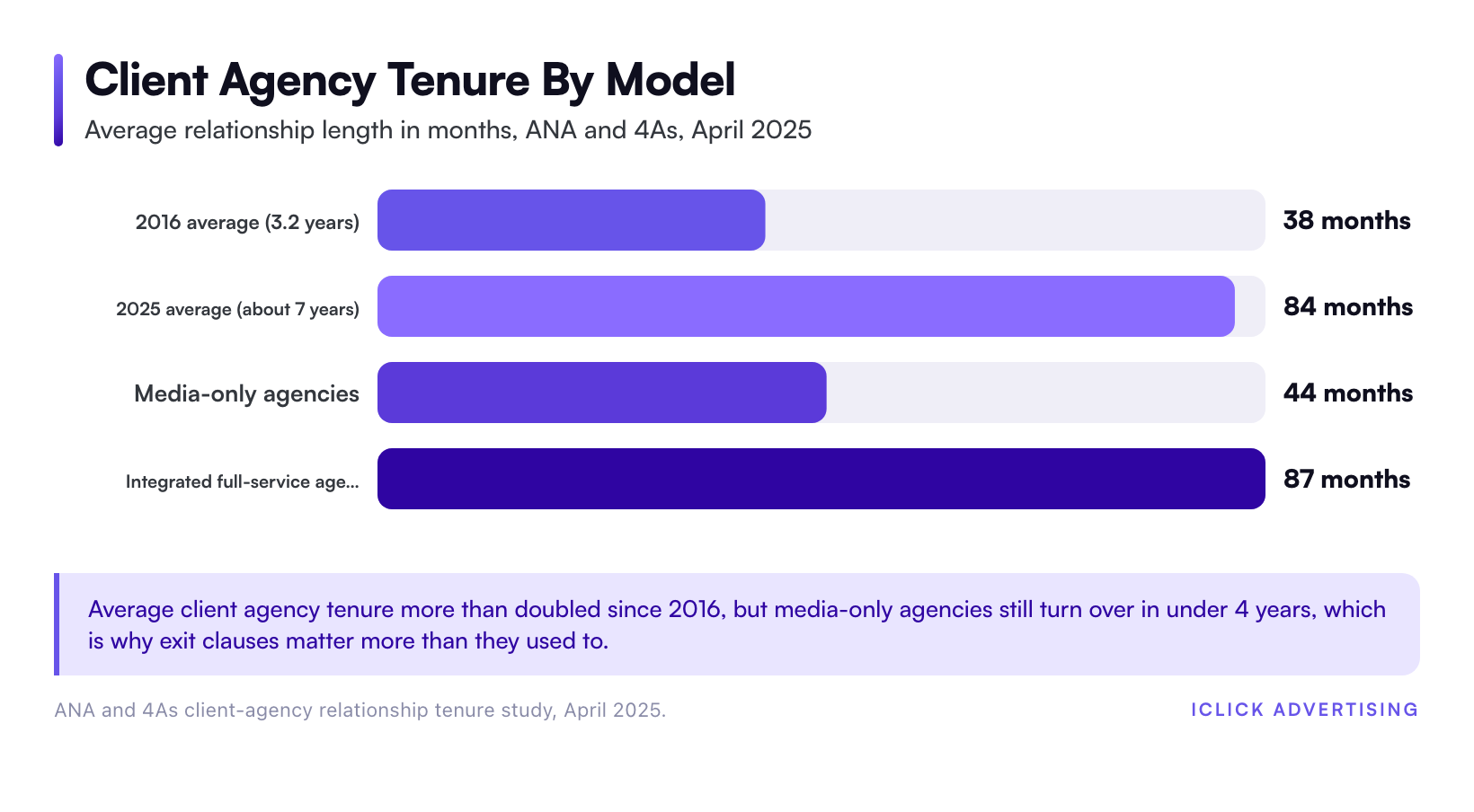
The stakes have gone up. The ANA and 4As reported in April 2025 that the average client agency relationship now runs about seven years, more than double the 3.2 years reported in 2016. Media-only agencies were the exception at 44 months. Focus Digital’s 2026 churn report puts the average retainer client lifespan at 56 months against 24 months for project work.
Longer relationships make the paperwork more important, not less. One bad clause compounds for years.
Below are the nine terms that cause the most damage, what each does in practice, and the replacement language to ask for. If you are still building a shortlist, pair this with the 23 questions that separate PPC pros from pretenders and the PPC Agency Buyer’s Checklist.
The 9 contract terms at a glance
| Term | What it does | What to ask for |
|---|---|---|
| Auto-renewal | Renews the term unless you cancel 60 to 90 days early | 30-day notice, no auto-renewal, written reminder |
| Account ownership | Agency creates and owns the ad accounts | Client-owned accounts, client admin seat |
| Percent of spend | Fee scales with budget, uncapped | Tiered rate, hard fee cap, no rebates |
| Minimum spend | Locks you into a monthly media floor | Quarterly average, written pause right |
| Creative ownership | Agency keeps ads, pages, and scripts | Work-for-hire assignment on payment |
| Data rights | Reporting through the agency dashboard only | Raw platform access plus export at exit |
| Non-solicit and exclusivity | Restricts you, not the agency | Mutual 12-month terms, category exclusivity |
| Additional services | Extras billed at undefined rates | Scope exhibit with named rates |
| Termination and offboarding | Access transfer tied to fee disputes | 10-day transfer, no transition fee |
The 9 terms that bite
1. Auto-renewal with a long notice window
The clause: the agreement renews for another 12 months unless you give written notice 60 or 90 days before the term ends.
Why it bites: nobody puts it on a calendar. You decide to leave in month 11 and the renewal already fired.
Two agencies can quote the same $4,000 monthly fee and carry very different risk. A 90-day notice period on an auto-renewing annual term means a late decision costs you $12,000 in fees you cannot stop.
Ask for: month-to-month after an initial 90-day ramp, or a 30-day notice period with no auto-renewal. If the agency insists on an annual term, ask for a written renewal reminder 30 days before the notice deadline. Serious shops send one without being asked.
2. Account ownership and admin access
The clause: the agency creates and owns the Google Ads account, then grants you view access.
Why it bites: your conversion history, audience lists, and account-level learning sit in an asset you cannot control.
Google’s documentation is clear on how this should work. A client account can only have one owner, and the client can always unlink a manager account, which removes that manager’s access while the account keeps its own campaign history. That protection only exists if the account is yours and an employee at your company holds admin access.
Meta works differently. Assets live in a business portfolio and agencies get partner access. If the agency’s portfolio owns the pixel, the catalog, and the ad account, you restart from zero the day you leave.
Ask for: client-owned Google Ads account, client-owned Meta business portfolio, client-owned GA4 property, and at least one admin seat that never leaves your company.
3. Percent of spend fees with no cap
The clause: fee equals 15% of monthly ad spend.
Why it bites: agency revenue rises with your budget whether or not the extra budget earns anything. Scaling from $20,000 to $80,000 per month quadruples the fee for work that rarely quadruples.
Percent of spend is not automatically bad. Uncapped percent of spend with no efficiency target is.
Check how media gets bought, too. The ANA’s December 2023 programmatic transparency study found that only 36 cents of every programmatic dollar reached working media after transaction fees and wasted impressions. If your agency resells display or programmatic inventory, ask whether you are paying true media cost or a marked-up rate.
Ask for: a tiered rate that steps down as spend grows, a hard monthly fee cap, and a sentence stating the agency takes no rebates, kickbacks, or undisclosed markups from any media vendor. Then read what PPC agencies actually charge.
4. Minimum spend commitments
The clause: client agrees to maintain minimum monthly media spend of $25,000 for the term.
Why it bites: it removes your ability to pull back in a slow quarter. It can also force budget into channels that stopped working, just to satisfy the floor.
Read carefully whether the management fee is calculated on actual spend or committed spend. Some contracts bill the percentage against the minimum even when you spend less.
Ask for: a quarterly average instead of a hard monthly floor, plus a written pause right of 30 to 60 days per year for seasonality, inventory problems, or cash flow.
5. Who owns the ads, landing pages, and scripts
The clause: agency retains ownership of all creative, copy, landing pages, and scripts developed during the engagement, licensed to client for the term.
Why it bites: you leave, and the landing page that produced your best conversion rate goes dark. Same for bidding scripts, feed rules, and Merchant Center supplemental feeds.
This shows up most with agencies that host pages on their own Unbounce or Webflow account. Find out where the pages live before you sign, not on your last day.
Ask for: work-for-hire language assigning every deliverable to you on payment, plus a clause requiring source files, page exports, script files, and feed rules delivered in editable format at termination.
6. Data access and reporting rights
The clause: agency provides monthly reporting through its proprietary dashboard.
Why it bites: a dashboard is not data. The login dies with the contract and you keep no history to benchmark the next agency against.
Watch call tracking and CRM seats too. If the agency owns the CallRail or HubSpot account, your call recordings and lead source data can walk out with them.
Ask for: raw platform access at all times, a Looker Studio or BigQuery export you control, and a clause requiring 24 months of exported performance data within 10 business days of termination. If you cannot pull your own search terms report today, that is already a problem. Our Google Ads audit checklist covers what you should be able to see on demand.
7. Non-solicitation, exclusivity, and category conflicts
The clause: client will not hire any agency employee for 24 months after termination, and the agency may serve competing accounts.
Why it bites: it runs one way. You are restricted, the agency is not. For a personal injury firm in one metro or a SaaS brand in a narrow category, an agency running two direct competitors sees both bid strategies and both budgets.
Ask for: category exclusivity defined in writing by vertical and geography, plus a mutual non-solicitation capped at 12 months and limited to people who actually worked on your account.
8. Scope definition and the additional services clause
The clause: services include Google Ads management. Additional services billed at prevailing rates.
Why it bites: prevailing rates are undefined. Landing page tests, feed work, and creative production quietly become line items.
Delivery disputes now drive churn more than results do. Focus Digital’s 2026 agency churn report, built from data collected January through April 2026, found 48% of departing clients cited delivery dissatisfaction, up 14 percentage points year over year. Vague scope is where those disputes start.
Ask for: a scope exhibit listing channels, campaign types, monthly test count, reporting cadence, and named team members with committed hours. Put the out-of-scope hourly rate in the contract, not in an email thread.
9. Termination, offboarding, and the final invoice
The clause: on termination, agency will transfer accounts subject to payment of all outstanding fees.
Why it bites: “subject to payment” turns account access into a bargaining chip during a billing dispute. Some contracts also add an offboarding or transition fee on the way out.
Confirm who funds the media, too. If the agency’s credit card pays Google, move billing to your own payment profile before you sign anything.
Ask for: an offboarding checklist attached as an exhibit, a 10 business day transfer deadline, no transition fee, and language stating that account access transfers regardless of any fee dispute. Unpaid invoices are a collections matter, not a hostage situation.
Red flags that should stop the signature
- The agency will not name the account manager who does the daily work.
- Ad accounts sit inside the agency’s manager account and cannot be transferred.
- The contract has no termination-for-convenience clause at any point in the term.
- Reporting is dashboard-only with no raw platform access.
- Fees are a percentage of spend with no cap and no performance floor.
- The scope is one sentence long.
How to negotiate without blowing up the deal
You do not need a lawyer to fix most of this. You need three redlines and a calm email.
Start with the three that cost real money: ownership, notice period, and scope. Ownership is non-negotiable. Notice period and scope usually move.
Send the redlines before the kickoff call, not after. Agencies that push back hard on client-owned accounts are telling you exactly how offboarding will go.
Trade instead of demanding. A 12-month term in exchange for a 30-day termination clause after month three is a fair swap. So is a lower percentage in exchange for a longer commitment.
Get every promise made in the sales call written into the scope exhibit. Verbal commitments about test volume and reporting cadence do not survive account manager turnover.
If the agency refuses to attach an offboarding checklist, that is your answer. Reasonable partners have one ready because they use it. Book a call if you want a second set of eyes on a specific clause.
What we sign, and what we do not
iClick Advertising is a Google Premier Partner and has managed $61M+ in cumulative ad spend since 2017 for clients including Zager Guitars, plus law firms and SaaS companies.
Our contracts run on client-owned accounts. Every Google Ads, Meta, and GA4 asset stays in the client’s name from day one, and we hold access through a manager link the client can sever without calling us.
We do not use auto-renewal. We do not charge transition fees. Scope lives in a numbered exhibit with named people and committed hours.
Google’s own Ads help documentation confirms how easily this happens: when a manager account creates a new client account, that manager becomes the account owner automatically, so an account set up by a previous agency can sit under that agency’s ownership until the advertiser unlinks it and grants ownership elsewhere.
For industry context, the 2025 ANA and 4As study of client agency relationship tenure found that media agencies average just 3.7 years (roughly 44 months) with their top clients, against 7.3 years for full service agencies and an overall average of about seven years.
Get a second opinion before you sign
If a contract is sitting in your inbox right now, the fastest way to test it is to look at the account it covers. A clean account backs up a fair contract. A messy one explains why the exit clauses are written the way they are.
Request a free written PPC audit. We review the live account, document what we find, and send it as a written report you own. No pitch deck, no obligation, and you can hand the findings to any agency you choose.
Related on iClick
Sources
- ANA and 4As, client-agency relationship tenure study (April 2025): average tenure about 7 years versus 3.2 years in 2016; media-only agencies 44 months
- ANA Programmatic Media Supply Chain Transparency Study (December 2023): 36 cents of every programmatic dollar reaches working media
- Focus Digital, Average Marketing Agency Churn 2026 Report (data collected January to April 2026): 48% of departing clients cite delivery dissatisfaction; 56-month retainer client lifespan versus 24 months for project work
- Google Ads Help, About ownership of client accounts: a client account can only have one owner and can always unlink a manager
- Google Ads Help, Unlink accounts from your manager account
- Meta Business Help Center, Add partners to your Business Manager (partner access model for ad accounts and pixels)
- Google Ads Help, About ownership of client accounts
- MediaPost coverage of the ANA/4As 2025 Client-Agency AOR Relationship Tenure report
Frequently asked questions
Can a PPC agency keep my Google Ads account if I leave?
Not if the account is genuinely yours. Google’s help center states a client account has one owner and can always unlink a manager account, which removes agency access while campaign history stays intact. If the agency built the account inside its own manager and never transferred ownership, recovery gets slow and awkward. Confirm your admin access before signing.
What is a fair notice period in a PPC agency contract?
Thirty days after an initial 90-day ramp is reasonable for most accounts. Ninety days is only defensible when the agency funds media or hired staff specifically for you. Push back on any auto-renewal requiring notice more than 60 days out, and ask for a written renewal reminder sent before the deadline arrives.
Should I sign a 12-month PPC contract?
Only with an exit. A 12-month term works if you get termination for convenience with 30 days notice after month three, no auto-renewal, and full account ownership. Without those three, you are funding a year of learning on someone else’s timeline. A long term should buy you a lower rate, not lock in an unproven partner.
Who owns landing pages an agency builds for me?
Whoever the contract says owns them. Default agency templates keep ownership with the agency and license it to you for the term only. Ask for work-for-hire assignment on payment plus delivery of source files, and host pages on your own domain and account. Otherwise your best converting page disappears the week you leave.
Are percentage of spend PPC fees a red flag?
No, but uncapped ones are. The agency earns more as budget grows, even when that incremental spend performs worse. Ask for tiered rates that step down above set thresholds, a monthly fee cap, and a written statement that the agency receives no rebates or undisclosed media markups from vendors.