

TL;DR: Adthena found that 51% of Google Ads spend sits in search terms Google hides as “other.” If your agency never brings that up, it’s one of the 14 red flags below. Most take five minutes to check in your own account. If you find three or more, get an independent written audit.
Why a red flags list beats a gut feeling
Most neglected accounts don’t crash. They drift. Spend holds steady, leads get a little more expensive, and the monthly report still looks green.
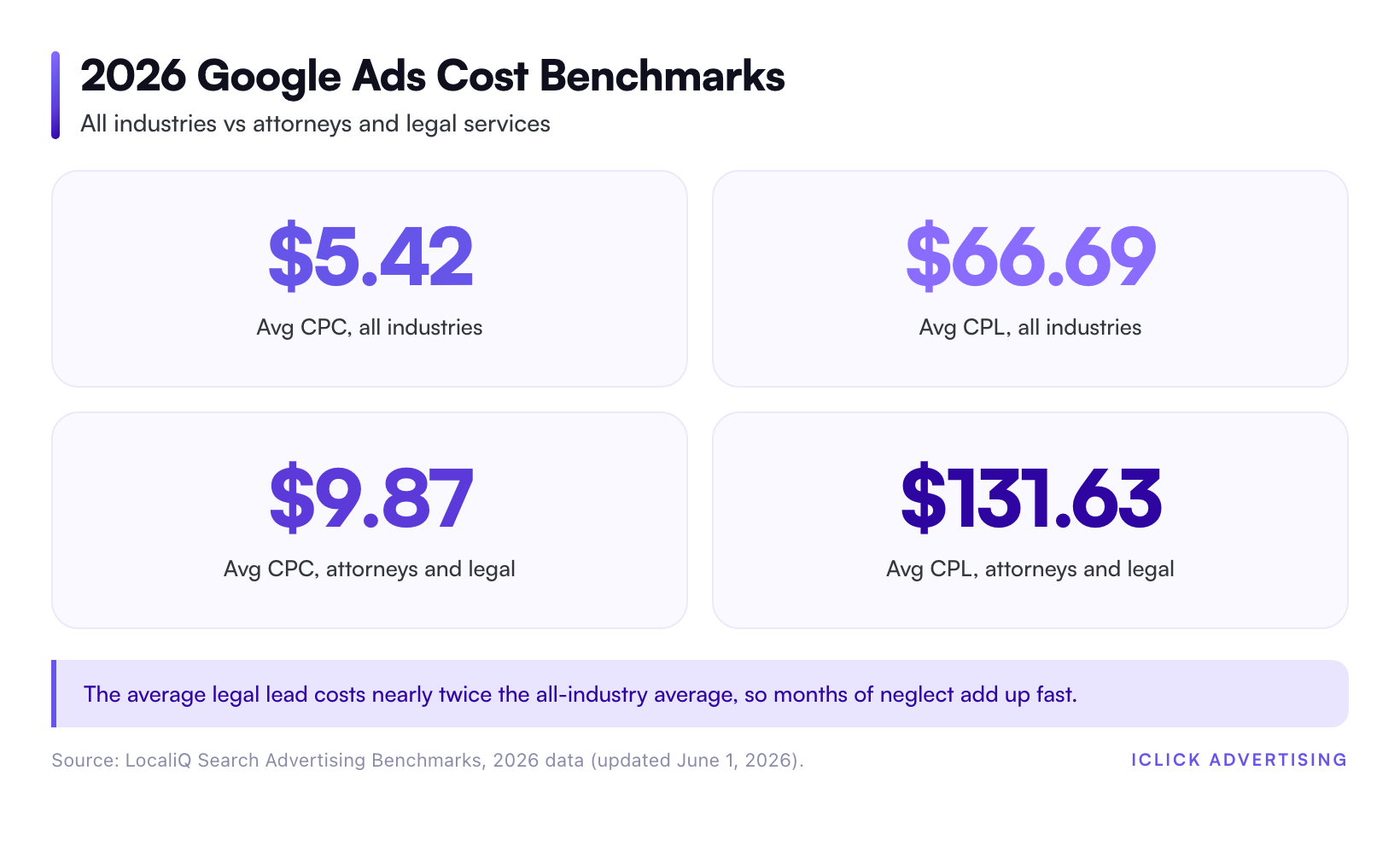
At today’s prices, that drift gets expensive. LocaliQ’s 2026 search advertising benchmarks put the average cost per click across all industries at $5.42. The average cost per lead is $66.69. For attorneys and legal services, the average CPL is $131.63. At those rates, a few months of neglect can cost more than most agency retainers.
Since 2017, iClick has managed $61M+ in ad spend across 250+ clients. The 14 signs below are the ones we check first when a new account lands on our desk. You can see every one of them from your own Google Ads login.
Access and transparency red flags
1. You don’t own your Google Ads account
If the account lives under the agency’s manager account and you have no admin login, you’re renting your own data. Ask for admin access today. A good agency grants it in minutes, because you’re the one paying Google.
If they stall, treat it as the loudest flag on this list. Years of conversion history and Quality Score data should leave with you, not with them.
2. Change history has gone quiet
Google Ads change history lists every edit made to your account, campaigns, and ad groups over the past two years. Open Tools, then Change history, and filter to the last 30 days.
A healthy account shows steady, dated work: new bid targets, new negatives, and ad tests. Weeks of silence mean nobody is working on it. A burst of edits the day before your monthly call means somebody is putting on a show.
3. Reports show clicks, not money
Impressions, clicks, and CTR measure activity. Your business runs on cost per acquisition, ROAS, and revenue. If the monthly report leads with traffic and buries cost per lead, ask why.
A report worth reading answers three questions. What changed? Why? What did it do to cost per result?
4. Nobody can explain the last three changes
Ask your account manager to walk you through the three most recent changes and the reason behind each one. That takes five minutes for someone who actually did the work.
Vague answers like “we optimized bidding” usually mean one of three things. The changes were automated, handed to a junior, or never made. Our guide on how to choose a PPC agency in 2026, with 23 questions that separate pros from pretenders, has more questions like this.
Wasted spend red flags
5. Nobody reviews the search terms report
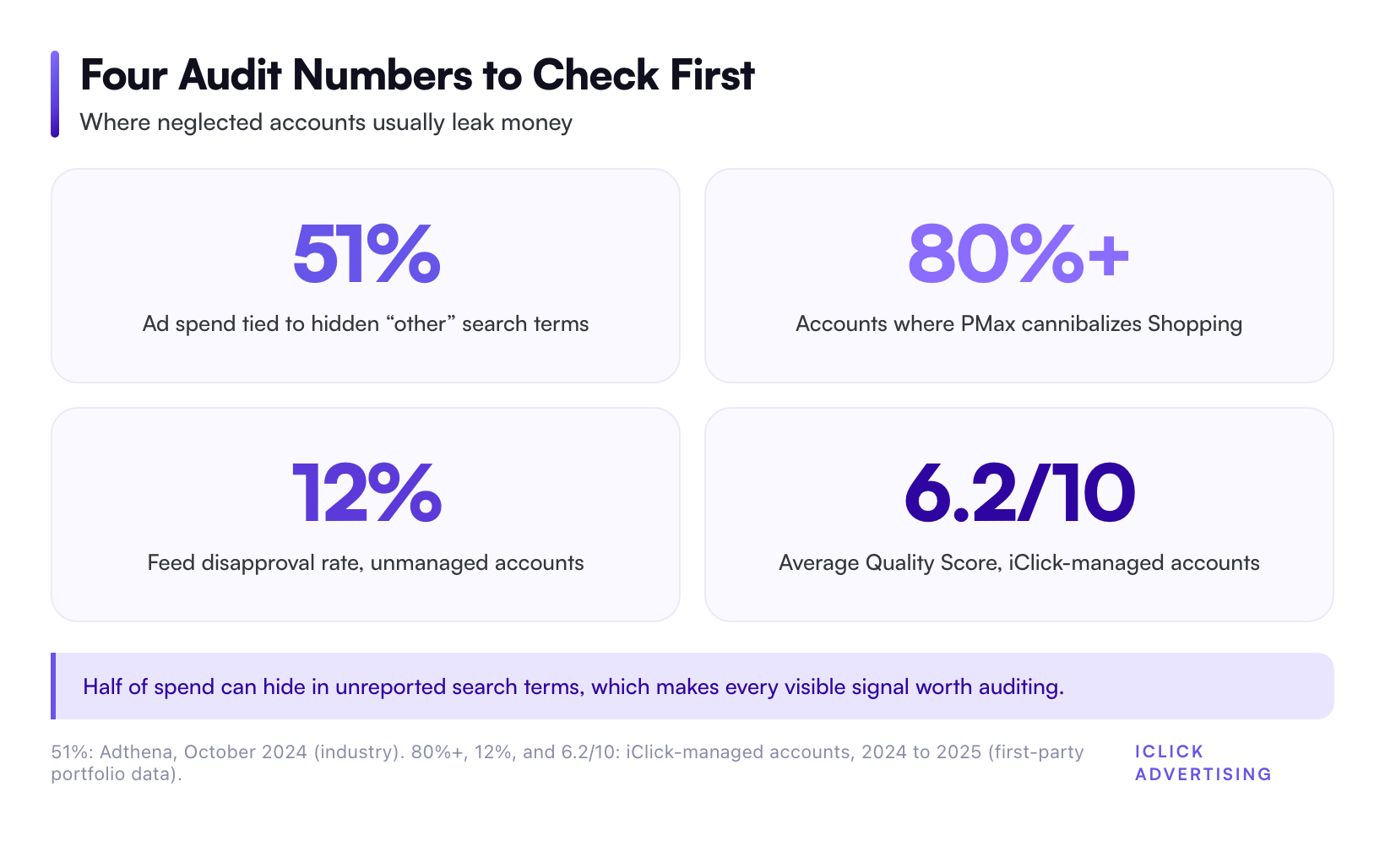
Your search terms report shows what people actually typed before they clicked. Google hides low-volume terms for privacy and groups them as “other.” Adthena’s October 2024 analysis found that, on average, 51% of ad spend is tied to those hidden terms.
That makes the visible half more important, not less. If your negative keyword lists haven’t grown in 90 days, nobody is mining the report. Look for irrelevant terms like “free,” “jobs,” or competitor names you never meant to buy.
6. Auto-apply recommendations are switched on
Google lets advertisers apply recommendations automatically. Google Ads Help lists the eligible options. They include “Add broad match keywords,” “Adjust your CPA targets,” and “Upgrade your conversion tracking.”
Each of those is a strategic call. When they run on autopilot, Google is managing your account while your agency bills for it. Open Recommendations, then Auto-apply, and see what’s ticked.
7. The agency brags about optimization score
Optimization score runs from 0 to 100%. It tracks how many of Google’s recommendations you’ve acted on. It doesn’t tell you whether you’re profitable.
Pushing the score to 100% often means adding broad match, raising budgets, and loosening targets. A manager who calls a high optimization score a win is grading your account against Google’s goals instead of yours.
8. Costs sit far above benchmark with no explanation
Benchmarks aren’t targets, but they work as a sanity check. LocaliQ’s 2026 data shows an average CPC of $9.87 for attorneys and legal services. If your legal account pays well above that and above the $131.63 average CPL, someone should be able to tell you why.
There are good reasons: an expensive metro, a high-value case type, or aggressive competitors. “That’s just the market” isn’t one of them. For a reference point from well-optimized accounts, see our 2026 PPC benchmarks from iClick-managed accounts.
Measurement red flags
9. Conversion tracking counts the wrong things
Open Goals, then Conversions, and read the list of primary actions. If page views, scroll depth, or phone number clicks sit next to real purchases or form fills, your results are inflated.
Smart Bidding optimizes toward whatever you call a conversion. Feed it soft signals and it will buy you cheap, useless clicks. Duplicate tags that count one sale twice are just as common, and they do just as much damage.
10. Lead gen accounts optimize to form fills, not revenue
For law firms, SaaS companies, and home services, a lead isn’t a sale. If your agency has never asked for CRM data or set up offline conversion imports, the bidding system can’t tell a signed case from a spam call.
That’s why we measure law firm accounts in signed cases. At Georgia Probate Law Group, cost per signed case fell 40% while qualified intakes rose 85% across two states.
Structure and hygiene red flags
11. Performance Max is eating your Shopping traffic
Performance Max can bid on the same products that your Standard Shopping campaigns already win. In iClick-managed accounts, PMax cannibalizes Shopping in 80%+ of accounts.
Ask for a side-by-side view of Shopping and PMax spend by product, before and after PMax launched. If nobody has checked for overlap, some of your “new” PMax revenue was already yours.
12. Merchant Center disapprovals pile up
Disapproved products don’t serve. iClick’s benchmark data shows a 12% feed disapproval rate in unmanaged accounts. That’s roughly one product in eight sitting out of the auction.
If you run an eCommerce brand, open Merchant Center and check product status. Disapprovals more than a week old mean nobody is watching the feed.
13. Quality Scores are stuck in the basement
Quality Score is Google’s 1 to 10 rating of expected CTR, ad relevance, and landing page experience. The average across iClick-managed accounts is 6.2 out of 10.
If your top-spending keywords sit at 3 or 4 and haven’t moved in months, your ad groups are probably too broad or your landing pages don’t match the search. Low scores usually mean you pay more per click.
14. Ads haven’t changed in months
Check the dates on your responsive search ads. If the newest one is six months old, nobody is testing copy. Also look for headlines that are all pinned to fixed positions. Pinning everything stops Google from testing combinations.
A related warning sign is fees that rise with your spend while the work stays flat. Our breakdown of PPC management pricing and what agencies actually charge in 2026 shows what each pricing model should buy you.
How many red flags is too many?
One or two flags can usually be fixed in a single conversation. Send your agency this list and ask for a written response.
Three or more point to a process problem, not a one-off slip. Flags 1, 2, and 9 are serious on their own. With no access, no activity, or broken tracking, you can’t trust any other number in the report.
A red flags check tells you something is wrong. It doesn’t tell you what the problem costs or how to fix it. That takes a structured review. Our 47-point Google Ads audit checklist, explained walks through every item. If you’re already shopping for a replacement, the PPC agency buyer’s checklist keeps the search honest.
What a fix looks like in practice
Neglect compounds, and so does attention. McEldrew Purtell, a catastrophic injury firm, is our clearest example. Within 90 days, conversions rose 697%, CPA fell 53%, and call volume doubled.
Not every account moves that fast. Across our portfolio, clients average a 41% lift against their conversion goal. If you want to hear how an account like that gets rebuilt, book a call with the iClick team.
Get a second opinion in writing
If you counted three or more red flags, get an outside view before your next contract renewal. iClick’s free written PPC audit covers 47 points and arrives as a PDF within five business days, with no sales call. It’s built for brands spending $20K+ per month. Request your audit and see exactly what the neglect is costing you.
Related on iClick
Sources
- LocaliQ, Search Advertising Benchmarks for Every Industry (2026 data, updated June 1, 2026)
- Adthena, How hidden search terms are impacting your Google Ads (October 7, 2024)
- Google Ads Help, About change history
- Google Ads Help, About applying recommendations automatically
- Google Ads Help, About optimization score
- iClick Advertising, 2026 PPC Benchmarks (iClick-managed accounts, 2024 to 2025)
- iClick Advertising, Case Studies (McEldrew Purtell, Georgia Probate Law Group)
Frequently asked questions
What are the biggest PPC agency red flags?
The three most serious are having no admin access to your own Google Ads account, a quiet change history, and conversion tracking that counts soft actions like page views. Any one of these makes every other number in your report unreliable. Other common flags include an unreviewed search terms report, auto-applied recommendations, and ad copy that hasn’t changed in six months.
How can I check if my PPC agency is neglecting my account?
Log into Google Ads and open Change history for the last 30 days. Google keeps two years of edits, so gaps are easy to spot. Then check your negative keyword lists, your auto-apply settings, and the date on your newest ads. If you can’t log in at all, you already have your answer.
Is a high optimization score a sign of good PPC management?
No. Optimization score runs from 0 to 100% and reflects how many Google recommendations you’ve acted on. Many of those recommendations add broad match keywords or loosen targets, which can raise spend without improving profit. Judge your agency on cost per acquisition, ROAS, and revenue instead.
When should I get an independent PPC audit?
Get one if you spot three or more red flags, if cost per lead has risen for two straight quarters, or before you renew an agency contract. An outside audit shows what the problems cost and how to fix them. iClick’s free written audit covers 47 points and arrives within five business days.