


TL;DR: Five PPC pricing models exist: percentage of ad spend, flat retainer, hourly, performance based, and hybrid. Our verdict: a flat retainer tied to a written scope wins for most accounts spending $5,000 to $150,000 per month. Percentage models quietly cost you 15% of every budget increase.
The Five PPC Pricing Models, Side by Side
Every agency proposal you read uses one of five pricing structures. The label changes. The math does not.
Here is how the five compare on the three things that actually cost you money: predictability, incentive alignment, and what happens when your budget moves.
| Model | How you pay | Typical range | Built-in incentive problem | Best fit |
|---|---|---|---|---|
| Percentage of ad spend | A cut of monthly media spend | 10% to 20% of spend | Rewards bigger budgets, not better returns | Spend above $50,000 per month with a real scaling plan |
| Flat monthly retainer | Fixed fee for a defined scope | $500 to $10,000 per month | Rewards doing less work for the same fee | Most accounts between $5,000 and $150,000 per month |
| Hourly | Billed per hour worked | $151.88 per hour average for US PPC firms | Rewards slow work and long meetings | Finite projects: audits, migrations, rebuilds |
| Performance based | Per lead, per sale, or a share of revenue | Varies widely by vertical | Rewards cherry-picking the easy conversions | Mature accounts with clean conversion tracking |
| Hybrid | Base fee plus a smaller percentage | $1,000 to $3,000 base plus 5% to 10% | A milder version of the percentage problem | Accounts scaling spend fast across new markets |
Ranges above come from AgencyAnalytics’ PPC pricing guide (July 17, 2025) and Credo’s digital marketing pricing survey.
Percentage of Ad Spend
You pay a cut of what you spend on media. Most agencies charge 10% to 20%, usually with a monthly floor.
At $20,000 per month in spend and a 15% rate, your fee is $3,000. Push spend to $40,000 and your fee becomes $6,000.
Your workload did not double. The keyword count did not double. Only the invoice did.
Where it works
Percentage pricing is honest when spend growth genuinely creates work. New countries, new platforms, and new feed-driven campaigns all take real hours.
It also caps your downside. If you pause spend for a slow quarter, the fee drops with it.
Where it breaks
The agency gets paid more for spending more, even when the smartest move is spending less. That conflict never fully goes away.
If you accept this model, negotiate two things. Ask for a tiered rate that steps down as spend climbs. Ask for a hard dollar cap on the fee.
Flat Monthly Retainer
You pay a fixed fee for a written scope. Your budget can swing 50% in either direction and the fee stays put.
This is the model we recommend for most advertisers, and the reason is simple. It separates the agency’s pay from your media budget entirely.
Nobody has a reason to talk you into a budget increase. Nobody has a reason to talk you out of one.
Where it breaks
Flat fees fail when the scope is vague. “Ongoing optimization and monthly reporting” is not a scope. It is a sentence.
Six months in, the fee is unchanged and the work has quietly shrunk to a bid adjustment and a dashboard link.
The fix is a scope document that names deliverables, cadence, and the people doing the work. Our PPC agency buyer’s checklist covers exactly what that document should list.
Hourly Billing
The average US-based PPC agency charges $151.88 per hour, according to Credo’s pricing survey. About 85% of firms fall between $50 and $150 per hour.
Hourly billing has one structural flaw: it pays for time, not outcomes. A slow team earns more than a fast one.
It does make sense for finite work with a clear finish line. A one-time account audit, a Google Analytics 4 migration, or a shopping feed rebuild all price cleanly by the hour.
If you are buying a diagnostic rather than ongoing management, read what a Google Ads audit should include first. Then you can tell whether 12 quoted hours is thorough or thin.
Performance Based Pricing
You pay per lead, per sale, or a share of tracked revenue. On paper, this is the fairest structure in the list.
In practice it has three failure points.
Attribution fights. The agency counts a form fill. You count a signed contract. Somebody is billing for the gap.
Cherry-picking. Paid per lead, an agency chases the cheapest leads available. That usually means branded search and remarketing, which you would have won anyway.
Nobody funds the losing tests. Good accounts get good through experiments that fail. Pure performance pricing gives the agency no reason to run them.
Performance pricing works best as a bonus layer on top of a base fee. Set a cost per acquisition target, then pay a defined bonus for beating it. Keep the base fee big enough to fund real testing.
Hybrid: Base Fee Plus a Small Percentage
You pay a base retainer of roughly $1,000 to $3,000, plus 5% to 10% of media spend. The base covers tools, tracking, and reporting. The percentage covers scale.
This is the right answer for one specific situation: accounts growing spend quickly across multiple platforms or regions.
The base keeps the agency solvent through slow months. The percentage funds the extra headcount a $200,000 month actually requires.
Watch the total. A $2,000 base plus 8% of $75,000 in spend is $8,000 per month. Compare that against a straight flat quote before you sign.
What Each Model Costs at $20,000 in Monthly Spend
Abstract percentages hide real dollars. Here is the same account priced five ways.
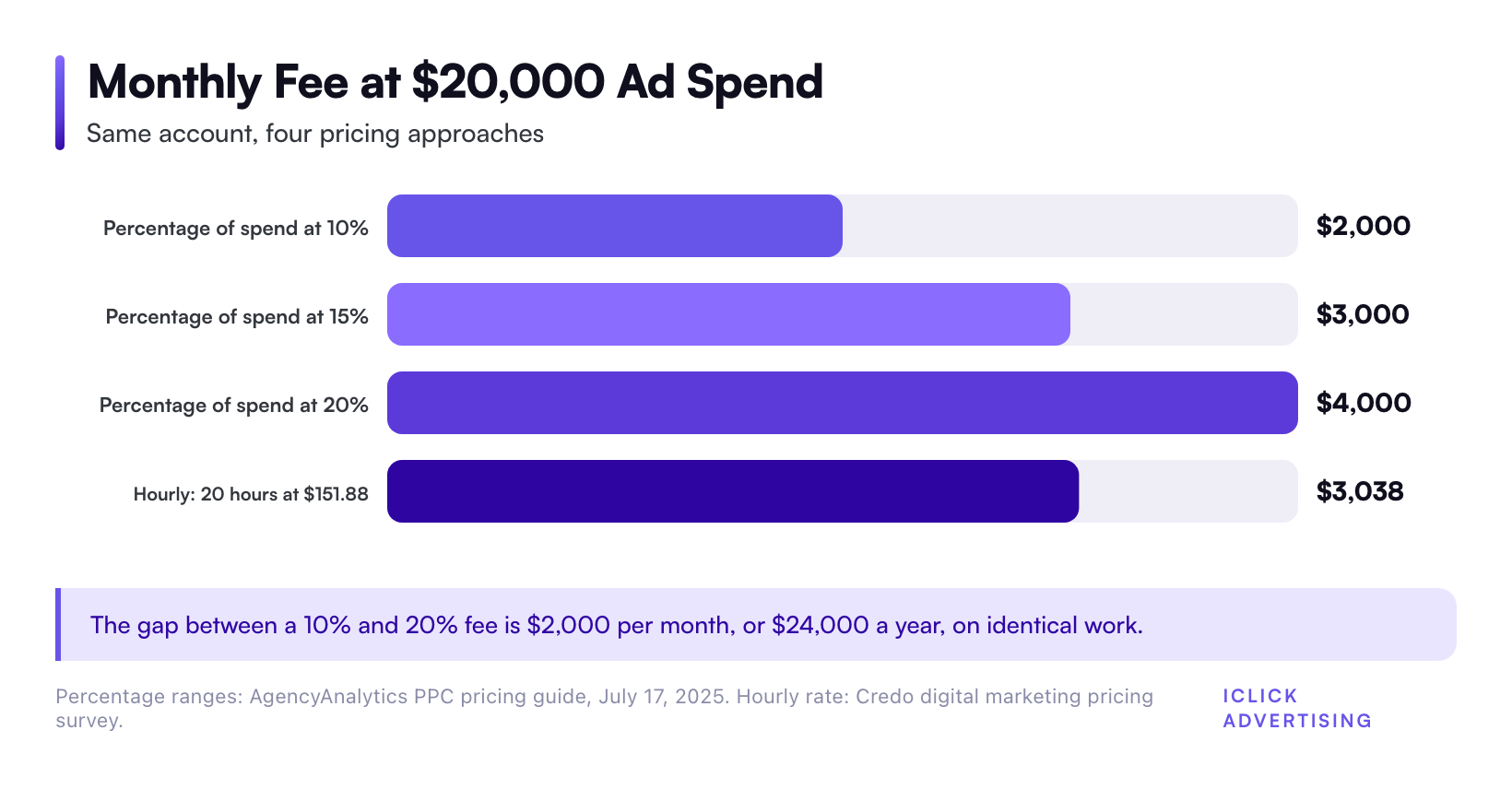
A 10% rate and a 20% rate are separated by $2,000 per month, or $24,000 a year. That is a full-time contractor’s worth of budget riding on one line in a contract.
The hourly comparison is the useful one. Twenty hours per month at $151.88 is $3,038. If a 15% fee on your spend buys fewer than 20 hours of senior attention, you are overpaying regardless of the model.
Ask any agency how many hours per month your account gets, and who logs them. The answer tells you more than the pricing page did.
The Numbers That Matter More Than the Model
Fee structure is a rounding error next to account performance. The benchmark data makes that obvious.
WordStream’s 2026 Google Ads Benchmarks report analyzed more than 13,000 US search campaigns running from April 2025 through March 2026. The all-industry average cost per click was $5.42. Average conversion rate was 8.18%. Average cost per lead was $66.69.
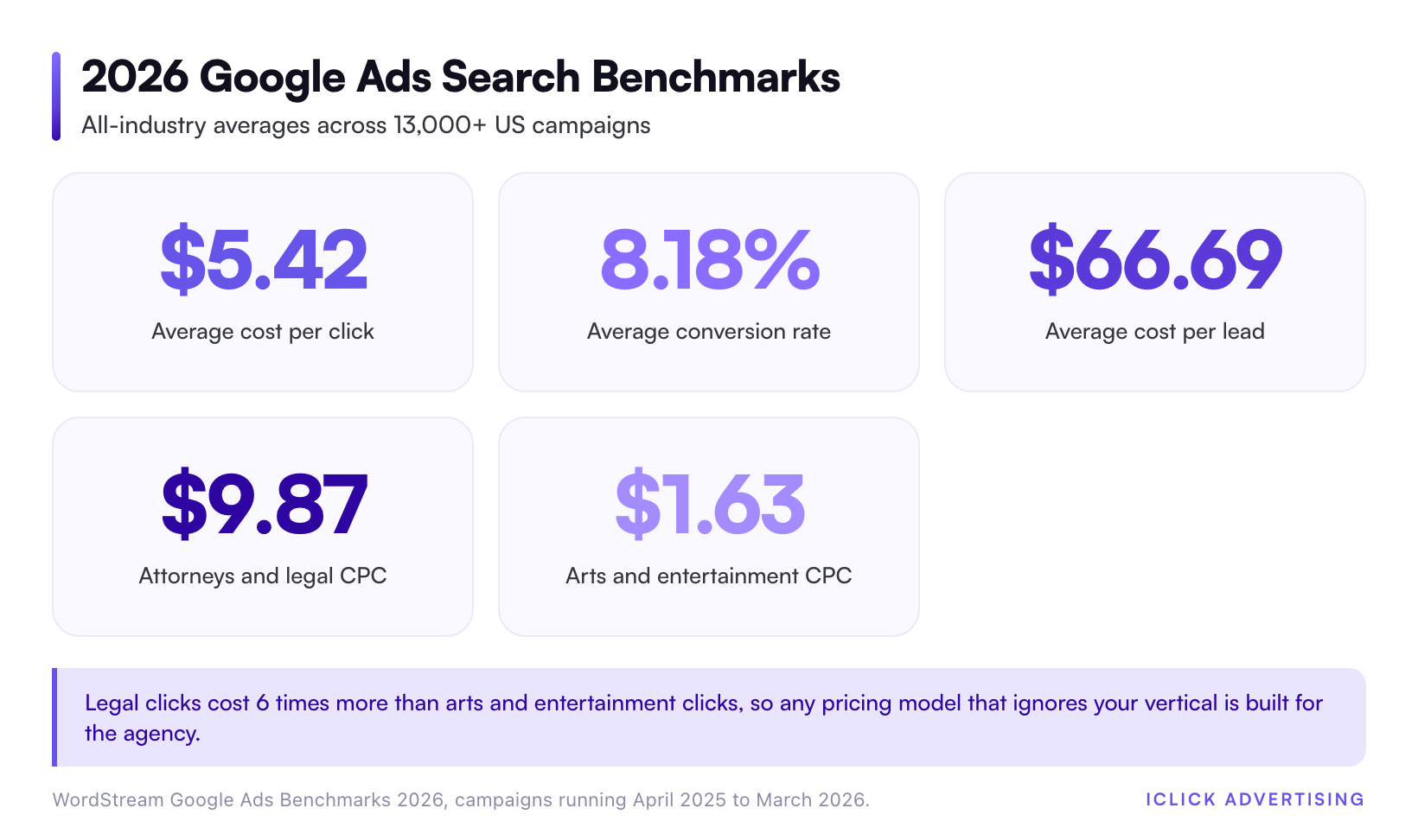
Run the math on a $20,000 monthly budget. At $5.42 per click you buy about 3,690 clicks. At an 8.18% conversion rate, that is roughly 302 leads.
Now lift the conversion rate to 10%. Same budget, same clicks, 369 leads. That is 67 additional leads per month, worth about $4,400 at benchmark cost per lead.
Negotiating a fee from 15% down to 12% saves you $600. Fixing the conversion rate is worth seven times more.
The spread by industry matters too. Attorneys and legal services averaged $9.87 per click. Arts and entertainment averaged $1.63. A pricing model that ignores your vertical’s auction economics is a pricing model built for the agency, not you.
Auctions are also getting more crowded. Search advertising pulled $114.2 billion in US revenue during 2025, up 11% year over year, per the IAB and PwC Internet Advertising Revenue Report released April 16, 2026. More money chasing the same clicks means execution quality compounds.
How iClick Prices PPC Management
We use flat retainers tied to a written scope, with a hybrid option for accounts above a defined spend threshold. No percentage-only contracts.
Two reasons. First, our clients’ budgets move seasonally. Artist merchandise stores for Beyonce, Linkin Park, and Ozzy Osbourne spike hard around releases and tours. A percentage fee would punish them for exactly the months they need us most.
Second, we manage $61M+ in ad spend. At that volume, percentage pricing would pay us for the budget rather than the work.
We are a Google Premier Partner, which Google’s own partner documentation defines as the top 3% of participating companies in a country, evaluated annually on client growth and ad spend growth. That status is earned on results, not on how we invoice.
Five Questions to Ask Before You Sign
- What exactly do I get each month, in writing? Ask for deliverables and cadence, not adjectives.
- If my budget drops 40% next quarter, what happens to my fee? The answer separates flat from percentage in one sentence.
- Who touches my account, and how many hours? Get names and a number. Compare against the $151.88 hourly benchmark.
- What happens in month one versus month six? Onboarding work is front-loaded. Pricing rarely reflects that.
- Do I own the Google Ads account, the conversion tracking, and the data? If the answer is no, walk away.
Our full vetting framework runs through 23 of these in how to choose a PPC agency in 2026. For dollar figures by agency tier, see what PPC agencies actually charge in 2026.
Match the Model to Your Spend
There is no universally correct pricing model. There is a correct model for your spend level and growth rate.
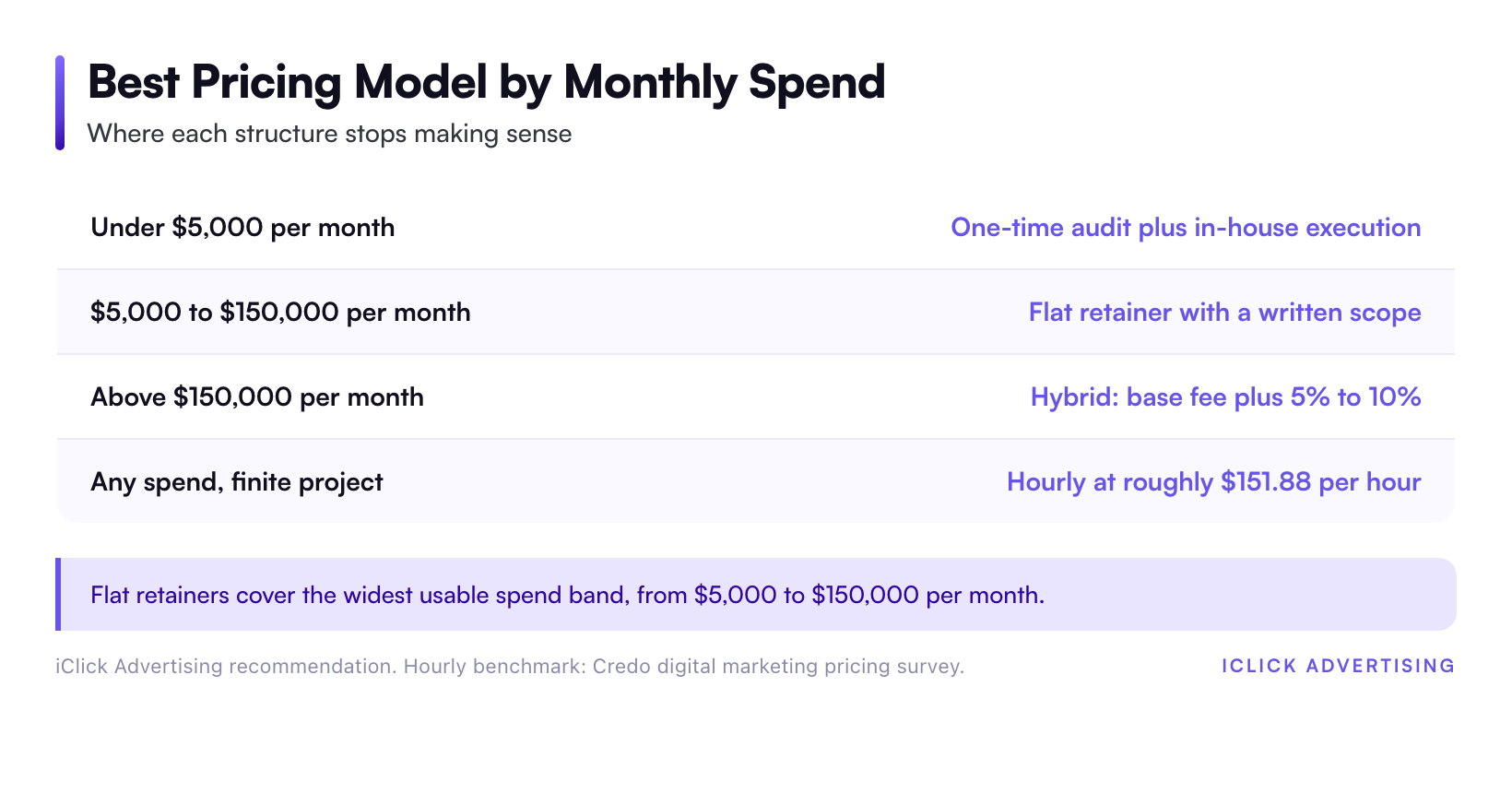
Under $5,000 per month, most agencies lose money on you. Expect a minimum fee, and expect a junior team. A one-time audit plus in-house execution often beats retained management at this level.
Between $5,000 and $150,000, flat retainers win. Predictable, scope-anchored, and free of budget-inflation incentives.
Above $150,000, hybrid pricing becomes reasonable. The percentage component funds the additional senior hours that scale genuinely requires.
Get a Free Written Audit Before You Sign Anything
The fastest way to judge a pricing quote is to know what shape your account is actually in. A vague quote on a broken account is a guess dressed up as a proposal.
We will run a free written audit of your Google Ads account against our 47-point checklist. You get a document with specific findings, prioritized by dollar impact. No deck, no pitch call required.
Use it to pressure-test any proposal on your desk, including ours.
Request your free written PPC audit, or book a call if you want to walk through the findings live.
Related on iClick
Sources
- WordStream, Google Ads Benchmarks 2026 (13,000+ US campaigns, April 2025 to March 2026)
- IAB and PwC, Internet Advertising Revenue Report: Full Year 2025 (released April 16, 2026)
- Google Ads Help, How to become a Google Partner or Premier Partner
- Credo, Average PPC Agency Rates (Digital Marketing Industry Pricing Survey)
- AgencyAnalytics, PPC Management Pricing Guide (July 17, 2025)
Frequently asked questions
What is the most common PPC pricing model?
Percentage of ad spend is the most widely used structure, typically 10% to 20% of monthly media spend. It is common because it is easy for agencies to quote and scales their revenue automatically. Common does not mean best for you. It pays the agency more when you spend more, regardless of your return.
Is a flat fee or percentage of ad spend better for PPC management?
Flat fees are better for most advertisers spending $5,000 to $150,000 per month. Your fee stays predictable when budgets swing seasonally, and the agency has no financial reason to push spend increases. Percentage pricing makes more sense above $150,000 per month, when scaling genuinely creates proportional work.
Should I pay a PPC agency based on performance?
Use performance pricing as a bonus layer, not the whole fee. Pure pay-per-lead deals push agencies toward cheap branded clicks and away from the failed experiments that produce real wins. Set a base retainer that funds testing, then add a defined bonus for beating a cost per acquisition target.
How many hours of work should my PPC retainer buy?
Divide your monthly fee by $151.88, the average US PPC agency hourly rate in Credo’s pricing survey. A $3,000 retainer should buy roughly 20 hours of senior attention. If an agency will not tell you the hours or who logs them, treat that as a pricing answer.
Do PPC agencies charge setup fees on top of the monthly fee?
Many do, because onboarding work is front-loaded. Account rebuilds, conversion tracking, and audience setup all happen in month one. A setup fee is legitimate if the deliverables are written down. Ask what the fee covers and what happens if you leave after 90 days.