

TL;DR: Standard Shopping is not going away. Google has never set a sunset date, and its last confirmation still stands from February 2022. But Performance Max took 62% of Google Shopping spend in Q4 2025, and Dynamic Search Ads auto-upgrade in February 2027. Build your migration plan now, in seven steps.
Are Standard Shopping Campaigns Going Away?
No. Google has not announced a sunset date for Standard Shopping, and there is no migration notice sitting in your account.
The last direct word from Google is still February 17, 2022, when ads product liaison Ginny Marvin confirmed that Standard Shopping campaigns would be supported for the foreseeable future, as reported by Search Engine Land. Nothing has replaced that statement in the four years since.
That is the accurate answer. It is not the whole answer.
Google almost never announces a sunset before the replacement already owns the spend. Smart Shopping ended after Performance Max was ready. Expanded text ads ended after responsive search ads took the volume. Dynamic Search Ads got their notice in April 2026, long after automation had absorbed most of the job.
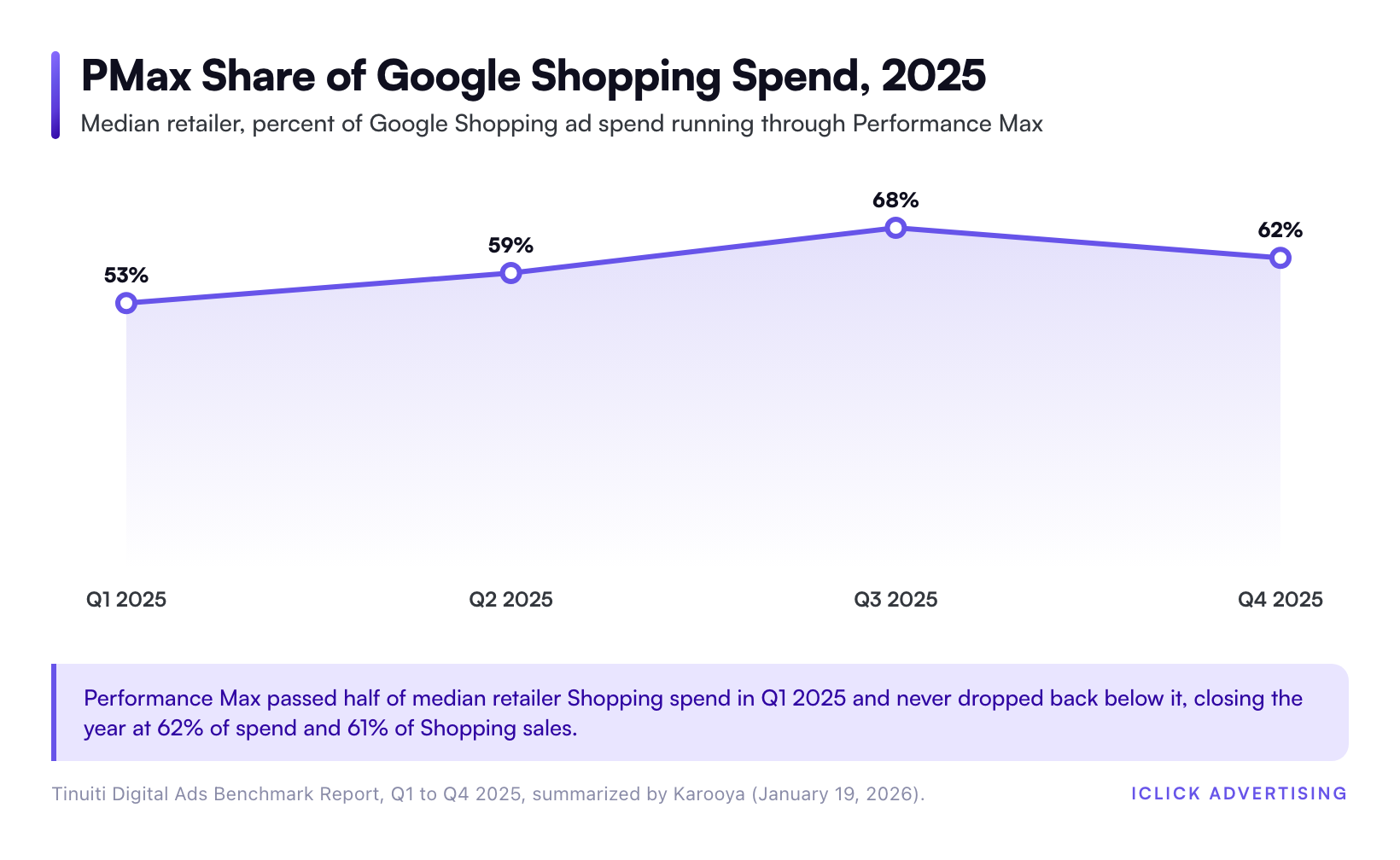
Standard Shopping sits on the same curve. Performance Max accounted for 62% of Google Shopping spend and 61% of Shopping sales for the median retailer in Q4 2025, according to the Tinuiti Digital Ads Benchmark Report summarized on January 19, 2026 by Karooya. Quarter by quarter through 2025, that share ran 53%, 59%, 68%, and 62%.
So the planning question is not whether Standard Shopping disappears. It is how much revenue would move if it did, and how fast you could replace the controls you lose. This playbook answers both.
What Google Has Actually Sunset, and What It Has Not
Confusing Smart Shopping with Standard Shopping is the single most common reason advertisers panic. They were different products with different fates.
Smart Shopping was retired. Every Smart Shopping campaign was auto-upgraded to Performance Max between July and September 2022. Standard Shopping came through that migration untouched and still ships in Google Ads, Google Ads Editor, and the API today.
Here is the live status of the retail campaign stack.
| Campaign type | Status | Key date |
|---|---|---|
| Expanded text ads | Sunset, creation stopped | June 30, 2022 |
| Smart Shopping | Sunset, auto-upgraded to Performance Max | July to September 2022 |
| Dynamic Search Ads | Sunset announced, upgrades to AI Max | Creation stops September 2026, upgrade February 2027 |
| Standard Shopping | Supported, no announced end date | Last Google confirmation February 17, 2022 |
| Performance Max | Active, default for retail | 62% of Shopping spend in Q4 2025 |
One change did quietly weaken Standard Shopping. Since October 2024, Performance Max no longer automatically outranks a Standard Shopping campaign targeting the same products in the same account. Google Ads serves whichever campaign carries the higher Ad Rank, the same rule it applies across campaign types (Google Ads Help).
That reads like a win for Standard Shopping. In practice, your Shopping campaign now has to beat Performance Max in a live auction on bid and quality, not on a structural rule that guaranteed it a lane.
The DSA Sunset Is the Template for What Comes Next
If you want to see what a Standard Shopping sunset would look like, read the Dynamic Search Ads notice. Google published the full pattern on April 15, 2026.
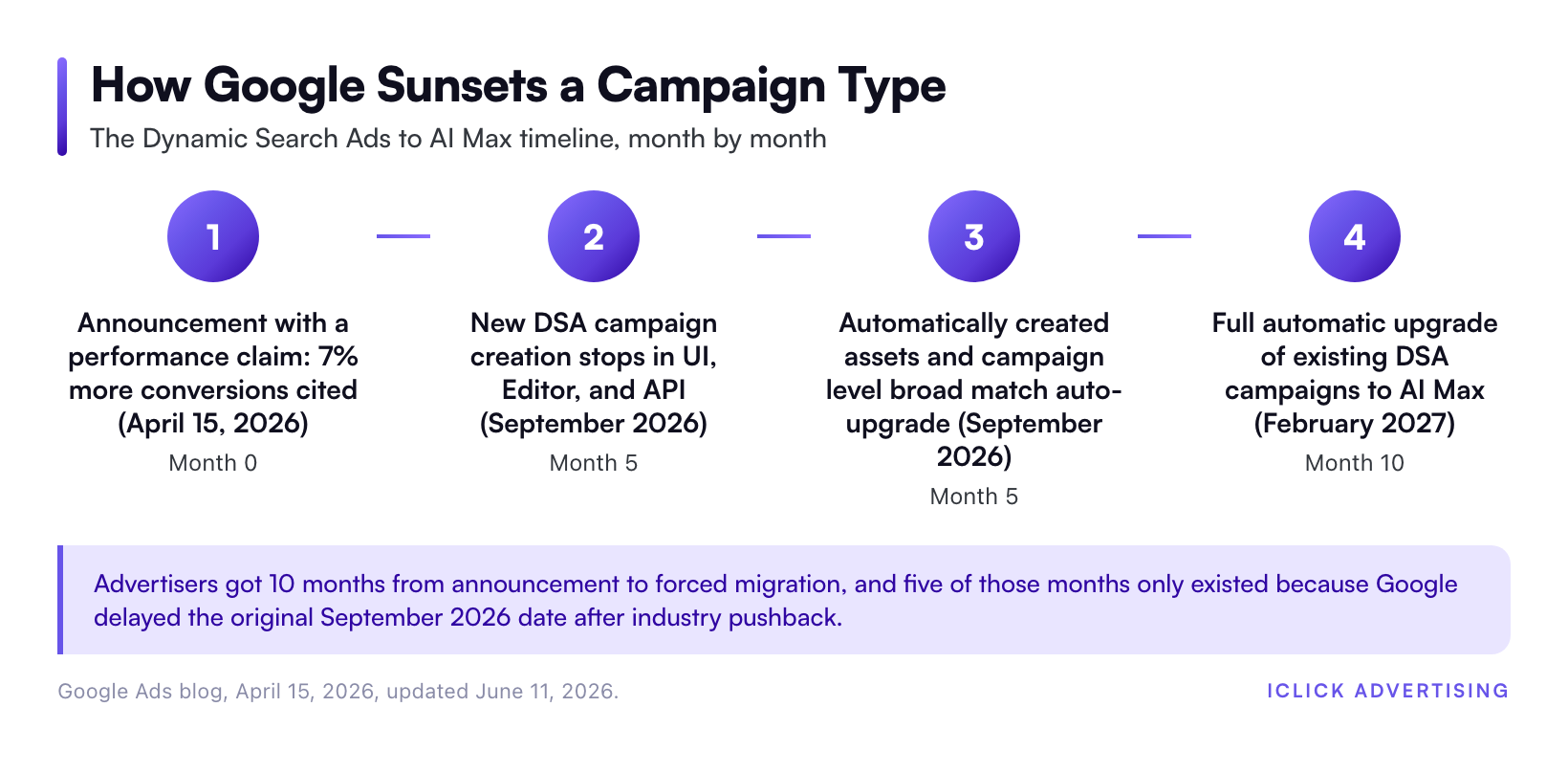
The sequence runs in four beats:
- The announcement arrives with a performance claim attached. Google said advertisers see an average of 7% more conversions or conversion value at a similar CPA or ROAS when using the full AI Max feature suite versus search term matching alone (Google Ads blog).
- New campaign creation stops first. For DSA, that lands in September 2026 across the interface, Editor, and the API.
- Existing campaigns get auto-upgraded later. Google pushed that date from September 2026 to February 2027 after advertiser feedback, per the same post updated June 11, 2026.
- Some sub-features migrate on the original schedule anyway. Automatically created assets and campaign level broad match still upgrade starting September 2026.
Read the gap. DSA advertisers got roughly 10 months of warning, and five of those months only existed because the industry pushed back. That is your realistic planning window for any campaign type Google decides to retire.
Ten months sounds generous. It is thin if your Shopping structure carries seasonal peaks, tens of thousands of SKUs, or margin tiers that Performance Max cannot see without help.
The Standard Shopping Sunset Playbook: Seven Steps
This is the readiness sequence we run inside our eCommerce PPC playbook whenever a client asks how exposed they are. Run it once and the answer stops being a guess.
Step 1: Write down what Standard Shopping is actually doing
Pull the last 12 months. Segment spend, revenue, and ROAS by campaign priority tier, by product type, and by branded versus non-branded search terms.
Most accounts find Standard Shopping is doing exactly one of three jobs: cheap brand defense, long tail query discovery, or margin protection on a specific set of SKUs. Name the job out loud. You cannot replace a function you never defined.
Step 2: Lock a 90-day baseline before you change anything
Export impression share, CPC, conversion rate, average order value, and blended ROAS at the product group level. Store it outside Google Ads in a sheet you control.
Once a campaign type is gone, the historical comparison goes with it. Judge the after against outside benchmarks too, not just your own last quarter. Our breakdown of good ROAS for eCommerce by category, margin, and channel gives you the reference range for your vertical.
Step 3: Fix the feed before you touch the campaigns
Performance Max has fewer levers than Standard Shopping, so the feed absorbs the difference. Titles, GTINs, product_type, and custom labels 0 to 4 stop being hygiene and start being your bidding strategy.
Custom labels are how you rebuild margin tiers, seasonality, bestseller status, and clearance logic after product level bids disappear. If your labels are empty today, you will not have a segmentation strategy after migration. You will have a budget and a hope.
Step 4: Rebuild segmentation inside Performance Max, not around it
Use listing groups and split by margin tier or product line. One asset group per tier, never one asset group for a 40,000 SKU catalog.
Structure still moves the number. Optmyzr’s study of 24,702 Performance Max campaigns, published June 16, 2025, found that accounts running multiple campaigns with a single asset group posted the best ROAS of any structure tested, and that 82% of advertisers were already running Performance Max alongside Search or Shopping rather than instead of it (Optmyzr).
Step 5: Run the experiment Google built for exactly this
Google Ads ships a native Standard Shopping versus Performance Max experiment. Use it instead of guessing.
Split 50/50, run a minimum of four weeks, and refuse to read the result until each arm has cleared at least 30 conversions. Anything shorter measures noise. If you need the full argument for which type should own your product ads, we covered it in Google Shopping vs Performance Max.
Step 6: Migrate in tranches by margin, never all at once
Move 20% of Shopping spend first, starting with the tier you could afford to lose for two weeks. Hold. Read the numbers against your Step 2 baseline. Then move the next tranche.
A full-catalog swap on a Monday gives you no attribution when revenue drops on Thursday. Tranches give you a control group for free.
Step 7: Rebuild the reporting you are about to lose
Standard Shopping hands you product level bids, a clean search terms report, and unambiguous channel attribution. Performance Max gives you asset group reporting, search themes, and channel breakdowns, but it will not give you a bid per product.
Build a Looker Studio view fed by the Google Ads API and joined to your Merchant Center product IDs before you migrate. Build it after, and you will spend the first month arguing about whether the drop is real.
What You Actually Lose, and the Closest Substitute
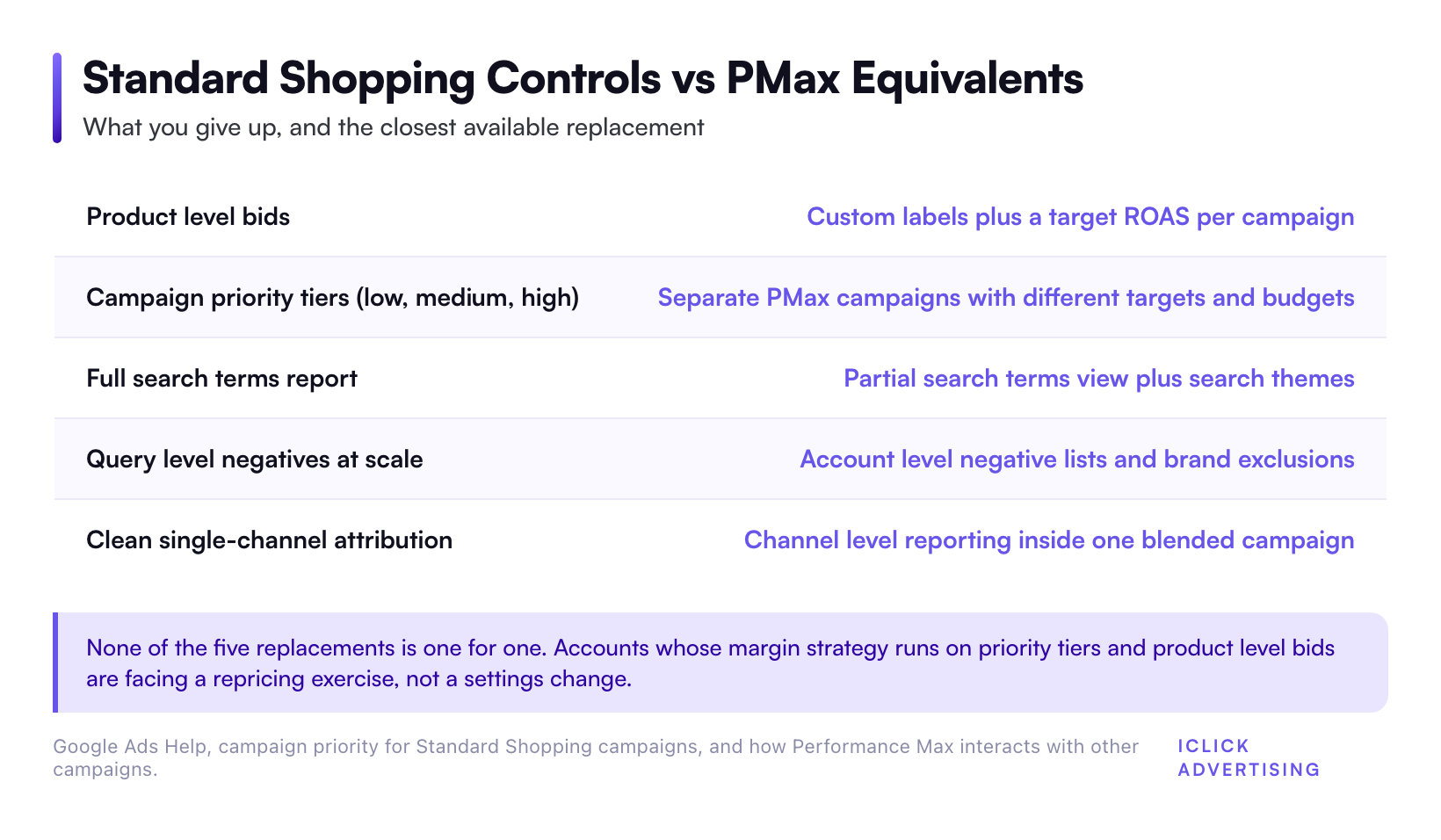
Every control has a replacement. None of the replacements are one for one.
- Product level bids become custom label segmentation plus a separate target ROAS per campaign.
- Campaign priority tiers become separate Performance Max campaigns with different targets and budgets. Google still documents priority for Standard Shopping in its campaign priority help page, and that setting has no Performance Max equivalent.
- The full search terms report becomes a partial search terms view plus search themes as a directional input.
- Query-level negatives at scale become account level negative lists and brand exclusions.
- Clean channel attribution becomes channel level reporting inside a single blended campaign.
Price the gap honestly. If your entire margin strategy runs on priority tiers and product level bids, migration is a repricing exercise, not a settings change.
When Keeping Standard Shopping Still Wins
Readiness is not the same as rushing. Four cases where Standard Shopping still earns its slot today:
Thin catalogs with heavy brand demand. Artist merch stores are the clearest example. A tour announcement spikes branded product queries overnight, and a Standard Shopping campaign with tight negatives buys that traffic at a fraction of the blended CPC.
High-consideration single-product sellers. A guitar buyer researches for weeks. Query-level visibility matters more than incremental reach, and Standard Shopping is the only Shopping surface that still shows you the query cleanly.
Regulated or claims-sensitive verticals. Supplement and device brands need to know which query triggered which product page. That is why we keep manual Shopping in the mix for health and wellness retailers more often than for general merchandise.
Accounts under the conversion volume automation needs. Smart bidding on a thin signal is guesswork with a nicer interface.
Outside those cases, the honest read is that Performance Max is already doing most of the work. We manage that split every day across eCommerce PPC accounts, including Shopify stores and DTC brands, and the structure logic behind it is documented in how we structure $61M of ad spend.
Your 30-Day Readiness Checklist
Four weeks gets you from exposed to prepared.
- Week 1: Export the 12-month segmentation from Step 1. Name the job Standard Shopping is doing. Lock the 90-day baseline in a sheet outside Google Ads.
- Week 2: Audit the feed. Fill custom labels 0 to 4 with margin tier, bestseller flag, season, clearance status, and stock depth. Clear every Merchant Center disapproval.
- Week 3: Draft the Performance Max structure on paper. One asset group per margin tier. Set a distinct target ROAS per tier. Build the Looker Studio view.
- Week 4: Launch the native experiment on 20% of spend. Write the decision rule before you see the data: what result makes you migrate, and what result makes you hold.
Do this now and a sunset announcement becomes a calendar item. Skip it and the announcement becomes a fire drill during Q4.
Find Out What You Would Lose Before Google Decides for You
Most Shopping accounts we look at cannot answer Step 1. They know their blended ROAS. They do not know which SKUs Standard Shopping is protecting, or what happens to those SKUs when the campaign type stops existing.
We will tell you. Our free written PPC audit reviews your Shopping structure, feed quality, custom label coverage, Performance Max overlap, and migration exposure, then sends you a written document with the specific gaps and the order to fix them. No pitch deck, no discovery call required.
Request your free written PPC audit and get your migration exposure in writing.
Related on iClick
Sources
- Search Engine Land, Google confirms Standard Shopping campaigns will remain available (February 17, 2022)
- Google Ads Blog, Google’s Dynamic Search Ads are upgrading to AI Max (April 15, 2026, updated June 11, 2026)
- Optmyzr, Performance Max study of 24,702 campaigns (June 16, 2025)
- Karooya summary of the Tinuiti Digital Ads Benchmark Report, Q4 2025 (January 19, 2026)
- Google Ads Help, How Performance Max interacts with other campaigns in your account
- Google Ads Help, Use campaign priority for Standard Shopping campaigns
Frequently asked questions
Are Standard Shopping campaigns going away in 2026?
No. Google has published no sunset date for Standard Shopping, and no auto-migration notice exists in Google Ads. The last official confirmation came from ads liaison Ginny Marvin on February 17, 2022, stating the campaign type would be supported for the foreseeable future. You can still create Standard Shopping campaigns in the interface, Editor, and the API today.
Will Google auto-migrate my Standard Shopping campaigns to Performance Max?
Not today, and not without warning. Smart Shopping was auto-upgraded between July and September 2022, but Standard Shopping was excluded. When Google does retire a campaign type, it stops new creation first and auto-upgrades existing campaigns months later. Dynamic Search Ads got roughly 10 months between announcement and forced upgrade.
Should I move Standard Shopping to Performance Max now or wait?
Test now, migrate on evidence. Run Google’s native Standard Shopping versus Performance Max experiment at a 50/50 split for at least four weeks, with 30 or more conversions per arm. Optmyzr’s June 2025 study of 24,702 campaigns found 82% of advertisers run Performance Max alongside Shopping or Search, not instead of it.
What controls do I lose if Standard Shopping is sunset?
Four things: product level bids, campaign priority tiers, the full search terms report, and clean single-channel attribution. Custom labels 0 to 4 plus separate Performance Max campaigns with distinct target ROAS values are the closest substitute. Fill those labels before you migrate, because they become your only real segmentation lever afterward.
Does running Standard Shopping alongside Performance Max hurt PMax performance?
It changes which campaign serves, not whether you get the impression. Since October 2024, Performance Max no longer automatically outranks Standard Shopping on the same products in the same account. Google Ads serves whichever campaign has the higher Ad Rank, so your Shopping campaign now competes on bid and quality instead of a structural rule.