

TL;DR: Conversational targeting uses AI to match ads to intent, not keyword strings; it now powers Google’s AI Max, Performance Max, and Meta’s Advantage+. The verdict: run both. Keyword targeting still wins for exact-match, high-intent terms, while conversational targeting captures the 1.5 billion monthly users now getting answers from Google’s AI Overviews.
What Is Conversational Targeting?
Conversational targeting is how AI ad systems match your ad to the intent behind a search, not the exact words typed into the box. Instead of bidding on a list of keyword strings, the algorithm reads the full query, the searcher’s context, and your site content, then decides if your ad fits.
Google AI Max for Search, Performance Max, and Demand Gen all run on this logic. So does Meta Advantage+. None of them ask you to type “running shoes for flat feet size ten.” They infer that intent from signals you feed the system: your landing page, your product feed, your past conversions, and your audience lists.
The Signals It Reads
- Query text and phrasing. Full natural-language questions, not just head terms.
- Session and search history. What the same user searched for minutes or days earlier.
- Landing page content. The AI crawls your page to confirm relevance before it serves the ad.
- Product feed data. Titles, categories, and attributes for every SKU you sell.
- Conversion history. Which past clicks actually turned into sales or leads.
This shift is not new. It has been building since Google widened broad match behavior in 2021 and accelerated once Smart Bidding models had enough conversion data to trust. What changed by 2026 is how much ad inventory now defaults to conversational matching instead of exact-string matching. We cover the full mechanics in our AI in PPC playbook.
Conversational Targeting vs Keyword Targeting: The Core Differences
Here is the side-by-side before we go deeper into when each one wins.
| Dimension | Keyword Targeting | Conversational Targeting |
|---|---|---|
| Input signal | Exact, phrase, or broad match keyword lists | Full query text, context, landing page, product feed |
| Match logic | String matching against your keyword list | Intent matching using machine learning models |
| Setup effort | High: keyword research, match types, negatives | Lower setup, higher asset and feed quality demands |
| Data needed to work well | Works from day one, even at low volume | Needs 30 to 50 conversions a month per campaign to learn |
| Best funnel stage | Bottom of funnel, high-intent, branded terms | Top and mid funnel, discovery, broad reach |
| Platforms | Google Search exact and phrase match, Microsoft Advertising | Google AI Max, Performance Max, Demand Gen, Meta Advantage+ |
| Control level | High: you approve every term you bid on | Lower: you approve signals, not individual queries |
Neither column wins outright. The table is the short version of a longer answer: it depends on your funnel stage, your data volume, and how much brand risk you can tolerate.
Where Conversational Targeting Actually Shows Up
Google’s Stack
Google runs three products on conversational matching right now: AI Max for Search, Performance Max, and Demand Gen. AI Max adds broad-match-style expansion and automatically created assets on top of your existing Search campaigns. Performance Max drops keyword targeting entirely and runs on audience signals and creative. Demand Gen targets intent signals across YouTube, Discover, and Gmail. We break down how each one works, and where they overlap, in Google’s AI Ads Stack, Explained: AI Max, Performance Max, and Demand Gen.
Meta’s Stack
Meta runs its own version through Advantage+ shopping campaigns, powered by the Andromeda retrieval algorithm. Andromeda scores ad-to-user matches with a neural network instead of the interest and demographic targeting Meta advertisers relied on before 2023. For the mechanics, see Meta’s AI Ads Stack, Explained: Advantage+ and the Andromeda Algorithm.
The Data Behind the Shift
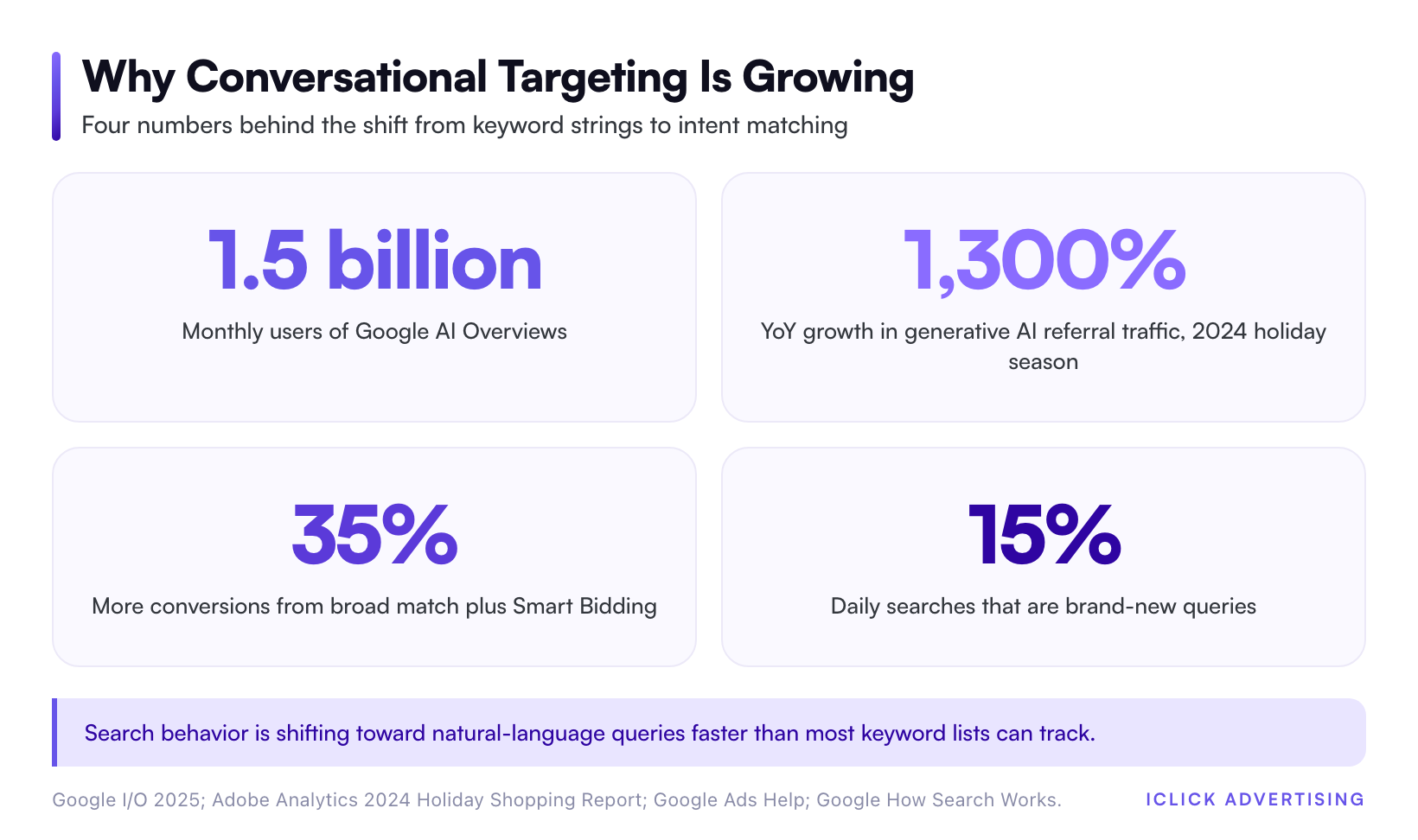
Four numbers explain why platforms keep pushing conversational targeting.
Google’s AI Overviews reached 1.5 billion users a month across more than 100 countries, according to Google’s I/O 2025 keynote in May 2025. That is 1.5 billion people getting answers shaped by natural-language queries, not keyword strings.
Traffic to U.S. retail websites from generative AI sources grew by 1,300% year-over-year during the 2024 holiday shopping season, per Adobe Analytics’ 2024 Holiday Shopping Report published in November 2024. Shoppers are increasingly arriving from a conversation, not a search box.
Advertisers who combine broad match keywords with Smart Bidding see an average of 35% more conversions or conversion value at a similar cost-per-acquisition, according to Google Ads Help documentation. Broad match is the closest keyword-based equivalent to conversational matching, and pairing it with automated bidding is Google’s own recommended bridge between the two systems.
Google has also said for years that roughly 15% of searches it sees every day are new, queries its systems have never processed before. Long, specific, conversational phrasing is a large part of why that number stays high.
When Keywords Still Win
- Branded and near-branded terms. You know exactly who is searching “Zager Guitars acoustic” and what they want. Exact match keeps that traffic cheap and controlled.
- Compliance-heavy verticals. Law firm and financial services clients often need exact control over which query triggers which ad copy, for regulatory reasons an AI model will not infer on its own.
- Low-volume, high-value B2B terms. If you get eight searches a month for a $50,000 contract, Smart Bidding will not have enough data to optimize. Manual control wins here.
- Negative keyword defense. Keyword campaigns give you a hard block list. Conversational campaigns give you exclusions, but they are softer and slower to take effect.
When Conversational Targeting Wins
- Top-of-funnel discovery. You cannot write a keyword list for demand that does not know it exists yet. Conversational targeting can find it from your signals instead.
- Large product catalogs. E-commerce accounts with thousands of SKUs cannot build keyword lists for every variant. Feed-based conversational campaigns scale that automatically.
- Accounts with real conversion volume. If you already log 50 or more conversions a month per campaign, Smart Bidding has enough signal to outperform manual bids.
- Voice and AI search growth. Long, natural-language queries typed into ChatGPT or Gemini, or spoken into a phone, rarely match a tidy keyword list.
Common Mistakes When Testing Conversational Targeting
Turning off keyword campaigns cold
Cutting keyword campaigns to zero the same week you launch Performance Max removes your baseline. You lose the ability to compare performance, and you lose the negative keyword protection built up over years of exclusions.
Launching with thin conversion data
Smart Bidding needs 30 to 50 conversions a month per campaign before it learns reliably. Launch a conversational campaign on an account converting five times a month, and it will spend its way through a learning phase that never fully resolves.
Ignoring the search terms and asset reports
Conversational campaigns still generate reports. Performance Max has a search terms insights view. AI Max shows you which queries triggered expansion. Skip these reports and you find out about a brand-unsafe match after the budget is spent, not before.
How to Test Conversational Targeting Without Wrecking Your Account
- Run it in parallel, not as a replacement. Keep your keyword campaigns live. Add a conversational campaign alongside it with its own budget.
- Cap the test budget. Start with 10% to 20% of total spend. That is enough to generate a read without risking the account.
- Feed it real signals. Upload customer match lists, first-party conversion data, and a clean product feed before launch. Conversational targeting is only as good as the signals it gets.
- Check exclusions weekly. Review search term insights and brand exclusions every week for the first month, then every two weeks after that.
- Compare CPA and conversion volume at 30 and 60 days. Give it a full learning cycle before you judge results.
The Verdict: Run Both, Weighted by Funnel Stage
Most accounts should not choose one system. They should split budget by funnel stage. Keyword targeting, especially exact match, still owns bottom-of-funnel and branded intent. Conversational targeting is stronger for top-of-funnel discovery and large catalogs.
The accounts that struggle are the ones that treat this as an all-or-nothing switch. The ones that do well treat conversational targeting as a new channel to test with a real budget and a real timeline, not a forced migration.
See our full service breakdown at AI PPC management for how this split gets built and managed inside a live account.
Do You Need an Agency to Manage This?
Running keyword and conversational campaigns side by side means managing two different skill sets: manual bid and negative keyword discipline on one side, feed quality and signal management on the other. Some in-house teams handle this well. Others do not have the bandwidth to watch both.
We wrote an honest answer to whether AI removes the need for an agency at all in Will AI Replace PPC Agencies? An Agency’s Honest Answer. Short version: the tools got more automated, the judgment calls did not.
Not sure where your account stands before making this call? Take the AI-Readiness Score quiz to see how ready your current setup is for conversational targeting.
Find Out If Your Account Is Ready
Guessing which system fits your account wastes budget either way. Run your account through our free PPC tools to see where you stand before you shift a single dollar of spend.
Related on iClick
Sources
- Google, I/O 2025 keynote: AI Overviews reaches 1.5 billion users a month (May 2025)
- Adobe Analytics, 2024 Holiday Shopping Report: generative AI referral traffic to U.S. retail sites (November 2024)
- Google Ads Help: About broad match, Smart Bidding conversion lift
- Google: How Search Works, on the share of daily searches that are new queries
Frequently asked questions
What is conversational targeting in PPC advertising?
Conversational targeting is how AI ad platforms match ads to the intent behind a full search query instead of a keyword string. Google AI Max, Performance Max, Demand Gen, and Meta Advantage+ all use it, reading query context, landing pages, product feeds, and conversion history to decide which ad to serve.
Is conversational targeting the same as broad match?
No. Broad match is a keyword match type that expands around a term you still choose. Conversational targeting removes the keyword list entirely and relies on audience signals, feed data, and creative. Google Ads Help data shows broad match plus Smart Bidding delivers an average of 35% more conversions at a similar CPA, making it the closest keyword-based bridge to conversational systems.
Will conversational targeting replace keyword targeting entirely?
Unlikely for most accounts. Exact match keywords still give the tightest control over branded terms, compliance-heavy industries, and low-volume, high-value B2B searches. Conversational targeting wins for discovery and large catalogs. Most accounts perform best running both, split by funnel stage rather than picking one system.
How much conversion data do I need before testing AI Max or Performance Max?
Google’s Smart Bidding models need roughly 30 to 50 conversions a month per campaign to learn reliably. Below that volume, the campaign spends through an extended learning phase without stabilizing. Accounts with thin conversion data usually get better short-term results sticking with manual or enhanced CPC bidding on keywords.
Does conversational targeting work for law firms and other compliance-heavy industries?
It can, but with more caution. Law firms and financial services accounts often need exact control over which query triggers which ad copy for regulatory reasons. Many run conversational campaigns for top-of-funnel awareness while keeping exact match keywords in place for anything tied to legal claims or financial promises.