

TL;DR: Personal injury is the most expensive keyword set in Google Ads. Legal averages $9.87 per click and PI leads run $159.17. Do not pick a budget from a percentage of revenue. Work backward: average fee per case, target acquisition cost, conversion rates, then bid ceiling.
The real cost of personal injury PPC in 2026
Legal is the most expensive vertical in paid search. Attorneys and legal services posted the highest average cost per click of any industry at $9.87, according to WordStream by LocaliQ’s 10th annual Search Advertising Benchmarks, covering April 2025 through March 2026.
Treat that number as a floor, not a target. It blends cheap practice areas like estate planning with expensive ones. Personal injury sits at the top of the blended range, not the middle.
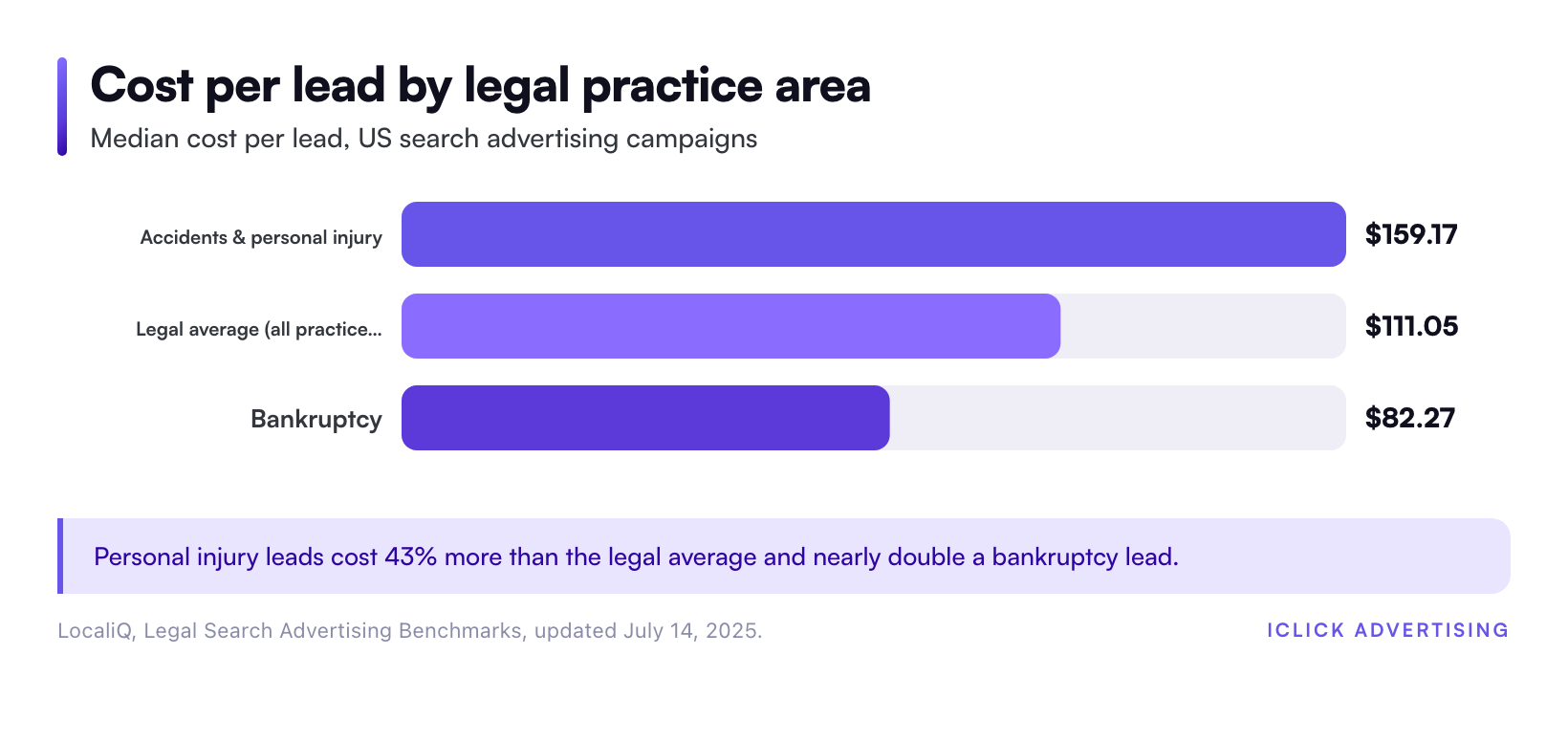
LocaliQ’s legal benchmark breakdown shows the gap plainly. Accidents and personal injury law carries the highest cost per lead of any practice area at $159.17. The legal average is $111.05. Bankruptcy sits lowest at $82.27.
A lead is not a case. Ten leads at $159 each is $1,590 in media spend. If two sign, your cost per signed case is $795. If none sign, you spent $1,590 on nothing and learned very little.
So the answer to “how much should we spend” is not a dollar figure an agency hands you. It is arithmetic that starts with your average fee per file and ends with a maximum bid.
Why personal injury clicks cost more than every other practice area
Contingency fees set the ceiling on click price
A standard pre-suit contingency fee is 33.3%. On a $60,000 settlement, the firm collects roughly $20,000. A contested divorce retainer might be $3,500.
A firm earning $20,000 per file can outbid a firm earning $3,500 per file on every auction, every day. The auction rewards whoever can afford the click, not whoever deserves it.
That is why family law clicks look cheap next to PI. LocaliQ puts family law at the lowest average cost per click in legal at $7.69, with tax law highest at $11.82. If divorce and custody are part of your mix, read our breakdown of advertising divorce and custody services profitably.
Every firm in your market bids on the same short keyword list
“Car accident lawyer”, “personal injury attorney near me”, “truck accident lawyer”, and a city name. That is most of the commercial search volume in any metro.
Hundreds of firms chase a few thousand monthly searches. Scarcity sets the price, not Google.
Quality Score changes what you pay for the same position
Two firms can hold the same ad position and pay very different prices per click. Ad Rank factors in expected click-through rate, ad relevance, and landing page experience.
A firm with a dedicated car accident landing page pays less than a firm sending every ad to its home page. This is the cheapest lever most PI accounts never pull.
Build the budget backward from case value
Percentage-of-revenue rules are useless here. They tell you nothing about whether an auction is winnable in your county. Use four steps instead.
Step 1. Find your average fee per signed case
Pull the last 24 months of closed files. Use attorney fee collected, not gross settlement value.
Then strip the outliers. A single $400,000 fee will distort a caseload built on soft tissue auto claims. Budget against the median, and treat catastrophic files as upside.
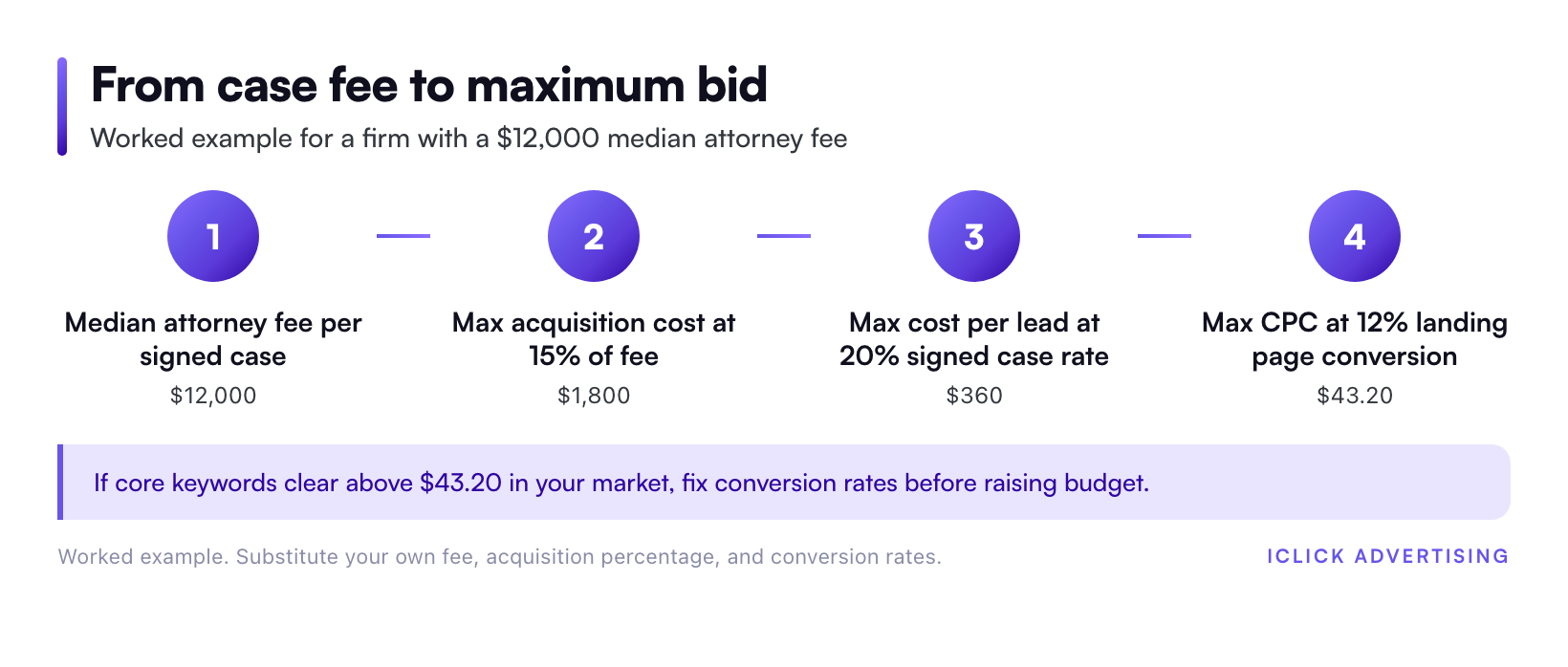
Say your median fee per signed case is $12,000. That is the input for everything below.
Step 2. Set a maximum cost per signed case
Most healthy PI firms hold client acquisition cost between 10% and 20% of the fee. At 15% of a $12,000 fee, your ceiling is $1,800 per signed case.
That one number governs every bid, every keyword, and every geography you buy. Our deep dive on cost per signed case, the only law firm PPC metric that matters, covers how to track it inside Google Ads.
Step 3. Work back through your two conversion rates
Two rates decide your bid ceiling: lead to signed case, and click to lead.
- If 20% of qualified leads sign, your maximum cost per lead is $1,800 multiplied by 0.20, or $360.
- If your landing page converts clicks to leads at 12%, your maximum CPC is $360 multiplied by 0.12, or $43.20.
Now compare that to your market. If “car accident lawyer” clears at $95 per click in your metro, you cannot buy that term at those conversion rates.
You have three moves: raise the signed case rate through intake, raise the landing page conversion rate, or buy cheaper inventory. Raising the budget is not on that list.
Step 4. Multiply by the case volume you actually want
Want six signed cases per month? Six multiplied by $1,800 is $10,800 in media spend, assuming your rates hold.
Then add management, tracking, and intake costs on top. Those are covered further down.
Volume alone is not the goal. The 2025 Clio Legal Trends Report, published October 29, 2025, found that growing firms nearly doubled revenue over four years while increasing clients and matters by only 50%. Better files beat more files.
What monthly budgets look like by market size
Case value math gives you a ceiling. Market size tells you whether the budget is large enough to produce readable data.
| Market tier | Example metros | Recommended monthly media floor | Time to reliable signal |
|---|---|---|---|
| Small metro or rural county, under 300,000 people | Boise, Springfield, Fort Wayne | $6,000 | 3 months |
| Mid-size metro, 300,000 to 2 million | Nashville, Kansas City, Charlotte | $20,000 | 2 to 3 months |
| Top-15 metro, over 2 million | Los Angeles, Houston, Atlanta, Miami | $50,000 | 2 months |
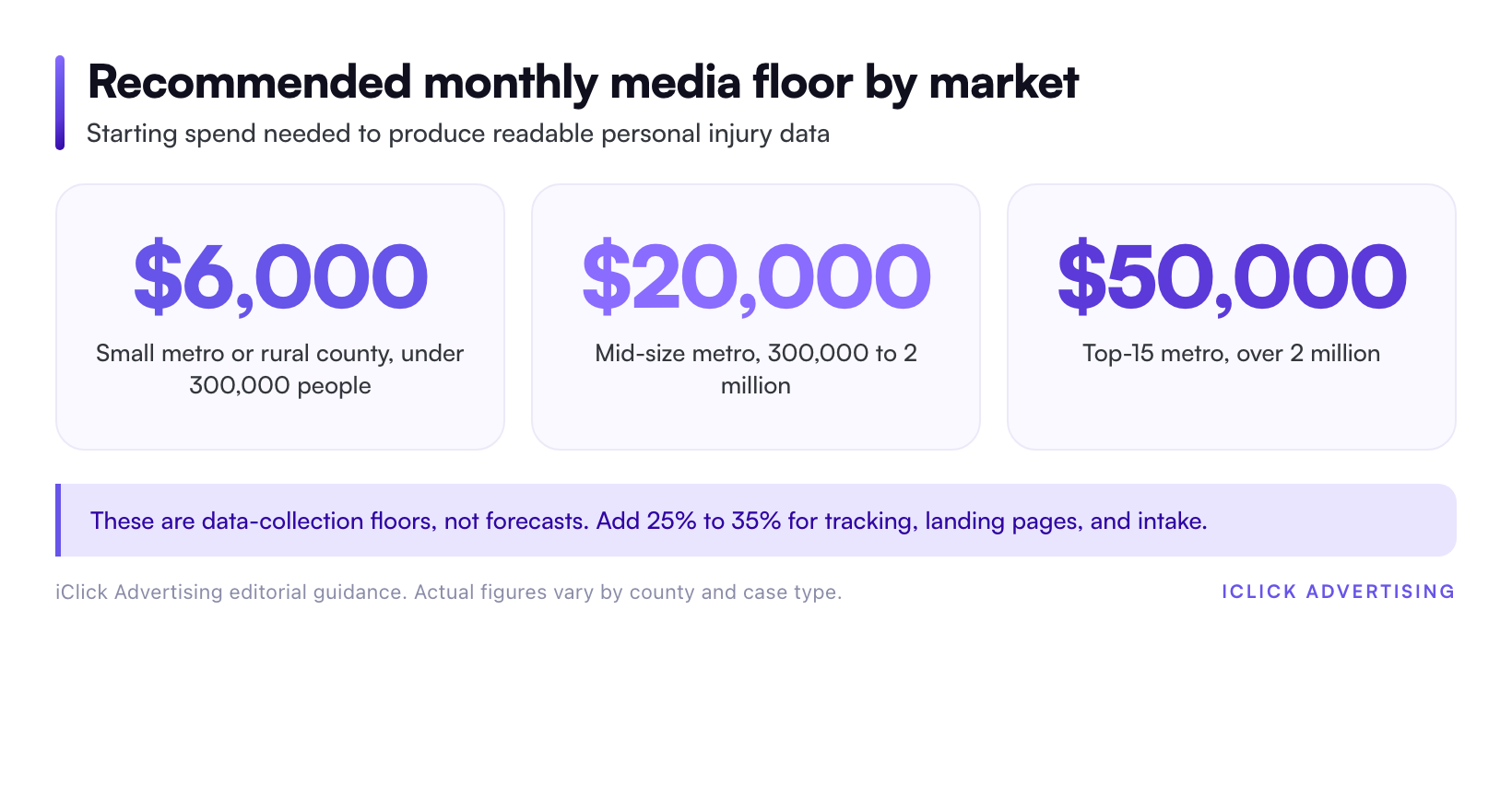
These are starting floors, not forecasts. Actual click costs and case volume vary by county, by case type, and by how many national firms are buying your zip codes.
The minimum budget worth starting with
Below a certain spend level, you cannot gather enough data to optimize anything. A campaign producing four clicks a day cannot tell you which keyword signs cases.
Use this rule: your monthly media budget should buy at least 30 clicks per week on your core keyword set. At $60 per click, that is roughly $7,800 per month. At $120 per click, roughly $15,600.
If you cannot fund that, do not split it across Search, Performance Max, and Display. Put all of it into one tightly geo-fenced Search campaign.
Or start with Local Services Ads, which bill per lead instead of per click. Google’s own documentation states you “pay only for leads related to your business and the services you offer.” Our Local Services Ads management guide for law firms walks through eligibility, badge verification, and lead credits.
The costs that are not media spend
Firms budget the click and forget the rest. Then they blame the click.
- Management: typically 10% to 20% of ad spend, or a flat monthly retainer.
- Landing pages: one page per case type. Car accident, truck accident, slip and fall, and wrongful death each need their own.
- Call tracking: CallRail, WhatConverts, or CallTrackingMetrics with dynamic number insertion. Without it you cannot tell which keyword produced the call.
- Intake coverage: live answering, nights and weekends included. PI prospects call once, then call the next firm.
- CRM: Litify, Filevine, or Lawmatics, wired back into Google Ads so signed cases import as offline conversions.
Plan on 25% to 35% above media spend for this layer. A firm spending $20,000 on clicks with voicemail after 6pm is buying leads it will never sign.
Where personal injury budgets get burned
Wasted spend in PI accounts is rarely exotic. It is the same seven items.
- Broad match keywords running without a mature negative list.
- No negatives for “jobs”, “salary”, “free”, “pro bono”, “law school”, or “how much is my case worth”.
- Ads pointing at the home page instead of a case-type page.
- Radius targeting that pulls in counties you would never file in.
- Counting form fills as conversions instead of signed cases.
- Running ads during hours when nobody answers the phone.
- Bidding on competitor brand names with no differentiating ad copy.
Three checks that tell you if you are overpaying
Run these monthly, in this order.
- Cost per signed case against your ceiling. If your ceiling is $1,800 and you are at $2,900, the account is unprofitable regardless of lead volume.
- Search terms report. Add up spend on queries you would never have chosen. Above 20% of total spend means your match types and negatives need work.
- Live answer rate. If fewer than 90% of calls are answered by a human, your click cost is not the problem.
For the full reporting cadence, bid strategy sequence, and account structure, work through our law firm PPC playbook. For practice-area specifics, see how paid search differs across law firm practice areas, including personal injury, family law, probate, and criminal defense.
Run your numbers before you raise your budget
Most PI firms do not have a budget problem. They have a cost per signed case they have never calculated.
Send us your Google Ads account and we will return a free written audit: your real cost per signed case, the wasted spend by search term, and the bid ceiling your case values actually support. No call required, no deck.
Related on iClick
Sources
- LocaliQ, Legal Search Advertising Benchmarks (updated July 14, 2025)
- WordStream by LocaliQ, Google Ads Benchmarks 2026 (data April 2025 to March 2026)
- Search Engine Journal, What Are Good Google Ads Benchmarks In 2026 (updated June 16, 2026)
- Google Local Services Ads Help, How Local Services Ads billing works
- 2 Civility, 2025 Clio Legal Trends Report coverage (October 29, 2025)
Frequently asked questions
What is a realistic monthly Google Ads budget for a personal injury firm?
In a small market, $6,000 per month is a workable floor. Mid-size metros usually need $20,000. Top-15 metros like Los Angeles or Miami start around $50,000. The right figure comes from your math: maximum cost per signed case multiplied by the number of cases you want each month, plus 25% to 35% for tracking, pages, and intake.
Why is personal injury the most expensive practice area in Google Ads?
Contingency fees are large, so firms can afford high bids. A $60,000 settlement produces roughly $20,000 in fees at 33.3%. LocaliQ’s legal benchmarks show accidents and personal injury carrying the highest cost per lead of any practice area at $159.17, against a legal average of $111.05. Everyone bids on the same short keyword list.
How do I calculate my maximum cost per click for personal injury keywords?
Start with median attorney fee per signed case. Multiply by your acceptable acquisition percentage, usually 10% to 20%. Multiply that ceiling by your lead-to-signed-case rate to get maximum cost per lead. Multiply again by your landing page conversion rate to get maximum CPC. A $12,000 fee at 15%, 20%, and 12% yields $43.20.
Should a small personal injury firm use Local Services Ads instead of Google Ads?
If your budget cannot buy 30 clicks per week, yes, start there. Local Services Ads bill per lead rather than per click, and Google’s documentation confirms you pay only for leads tied to services you offer. Badge verification takes time, so apply early. Many firms eventually run both, with Search covering case types LSAs do not.
How long before a personal injury PPC campaign shows whether it works?
Plan on two to three months of consistent spend. You need enough signed cases, not clicks, to judge performance, and PI intake-to-signature cycles run weeks. Judging an account on 30 days of lead volume produces the wrong decision almost every time. Track cost per signed case from day one so month three has something to measure.