

TL;DR: Value-based bidding tells Google what each conversion is worth, so Smart Bidding chases revenue instead of volume. Google’s data shows a median 14% lift in conversion value when advertisers move from Target CPA to Target ROAS. The catch: you need 15+ conversions in 30 days and real, varied values, whether that’s cart revenue, margin, or CRM-scored leads.
What is value-based bidding?
Value-based bidding is a Google Ads Smart Bidding approach that optimizes for the value a click is likely to produce, not the number of conversions. You tell Google what each conversion is worth. Google’s AI then bids more for people likely to bring more value, and less for people who aren’t.
The contrast is simple. Target CPA treats a $40 order and a $4,000 order as the same win. Value-based bidding does not. It chases the $4,000 order.
Google offers two value-based strategies: Maximize conversion value and Target ROAS (tROAS). Both are only as good as the values you send. That is the real work, so this post focuses on the signals, not the settings.
If you’re new to how Google’s bidding AI fits with the rest of the automation layer, our AI in PPC playbook covers the full picture.
How value-based bidding works inside Google Ads
In every auction, Smart Bidding predicts two things: the chance of a conversion and the value of that conversion. It combines them and sets a bid. Signals include device, location, time of day, audience lists, and the search query itself.
No human can weigh those signals in real time across millions of auctions. That’s the part the machine does well. Deciding what a conversion is worth is the part it can’t do without you.
Maximize conversion value vs Target ROAS
- Maximize conversion value spends your full daily budget to get the most total value. There is no efficiency guardrail.
- Target ROAS aims for the most value at a return you set. A 400% target means every $1 in spend should return $4 in conversion value.
Most accounts start on Maximize conversion value to gather data. They add a ROAS target once the numbers settle. Adding a target too early can starve a campaign of volume.
What Google needs before it will bid on value
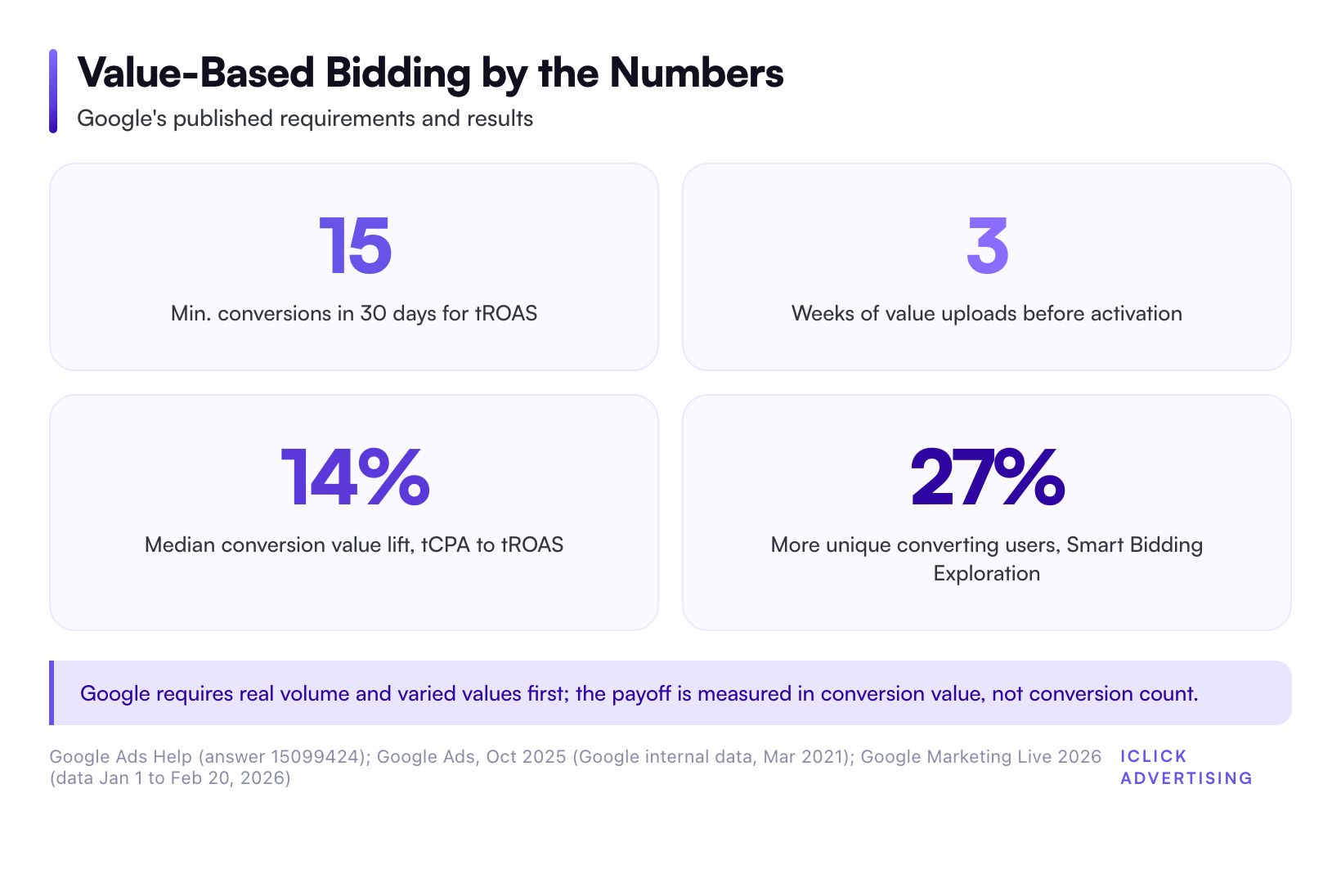
Google’s own documentation sets the minimum bar. Target ROAS should have at least 15 conversions in the last 30 days at the conversion tracking level. You also need two or more different values across your conversion goals. A flat $1 on every conversion is not value data.
Google also recommends uploading values for three weeks, or one to two conversion cycles, whichever is longer, before you switch value-based bidding on. Its best-practice guide then asks for a ramp-up period of at least two weeks before you judge results.
Why volume bidding leaves money on the table
Google’s internal data shows advertisers who moved from Target CPA to Target ROAS saw a median 14% increase in conversion value, even at similar ROAS. The figure is global Google data from March 2021, cited in Google’s October 2025 article on value-based bidding.
Fourteen percent more value at the same efficiency is not a rounding error. Here is the math on a hypothetical account. A $50,000 monthly budget at 400% ROAS produces $200,000 in conversion value. A 14% lift adds $28,000 a month without adding spend.
Google’s help center also cites Citibanamex, a Mexican bank. After adopting value-based bidding, it saw a 27% increase in credit card bookings and cut its cost per booked card by 7%. That’s a lead-gen business, not a store. The approach isn’t only for eCommerce.
The newest layer is Smart Bidding Exploration. You give Google a ROAS tolerance, and it tests less obvious queries. At Google Marketing Live 2026, Google reported that Search campaigns using it saw 27% more unique converting users on average. That figure covers January 1 to February 20, 2026. Google is now expanding it to Performance Max and Shopping.
Which revenue signals to feed Google
This is where most accounts win or lose. Google’s AI is only as smart as the number you attach to each conversion.
eCommerce: cart value first, then margin
For stores, pass the actual order value through the Google tag or your Shopify, BigCommerce, or WooCommerce integration. That’s the baseline. It’s also where many accounts stop, which is a mistake.
Revenue is not profit. A $200 order at a 15% margin earns $30. A $120 order at a 60% margin earns $72. If your catalog has mixed margins, the bidder will happily chase the wrong one.
You have two fixes. Send profit instead of revenue as the conversion value. Or use Google’s conversion value rules to raise the value of high-margin categories, new customers, or your best regions.
Revenue is also how we measure eCommerce results. Zager Guitars scaled from $300K to $1.5M a month at an 8.4 blended ROAS. Wish Rock Relaxation runs at 10x ROAS on $80K+ a month in spend. Both are named, on-record results in iClick’s client case studies.
Lead gen: proxy values and offline imports
Law firms, clinics, and home services don’t have a cart. They have leads, and leads vary wildly in worth. A catastrophic injury case and a minor fender-bender can fill out the same form.
The fix is proxy values. Assign each lead type a value based on its close rate and average fee. Then import offline conversions from your CRM, such as Salesforce, HubSpot, or Clio, so Google sees which clicks became signed cases.
Here’s a hypothetical. If 10% of injury leads sign and the average fee is $30,000, each lead is worth $3,000 as a proxy value. A lead type that signs at 2% with a $5,000 fee is worth $100.
That’s the difference between counting forms and counting cases. Georgia Probate Law Group’s result with iClick is measured in cost per signed case, which fell 40%. McEldrew Purtell saw CPA drop 53% and conversions rise 697% in 90 days.
SaaS: pipeline and lifetime value
For B2B software, a free trial and a closed $30,000 contract are not the same conversion. Assign values by stage: trial, qualified demo, opportunity, and closed deal. Weight each stage by its historical close rate and average contract value.
Our published benchmarks track SaaS on an LTV model rather than a ROAS figure for exactly this reason. Front-end revenue understates what a software customer is worth. Across our B2B SaaS accounts, the portfolio roll-up shows 30% lower CAC and 2x demos.
Setting a realistic ROAS target
Start from history, not ambition. Google advises basing your target on what the campaign has actually delivered. Setting 800% on a campaign that has averaged 300% will throttle spend almost immediately.
Your margin sets the floor. Breakeven ROAS equals 1 divided by your gross margin. At a 25% margin, breakeven is 400%, so a 300% target loses money on every sale.
Benchmarks help set expectations. The figures below come from iClick-managed accounts in 2024 and 2025, published on our 2026 PPC benchmarks page. They reflect well-optimized accounts, not market medians.
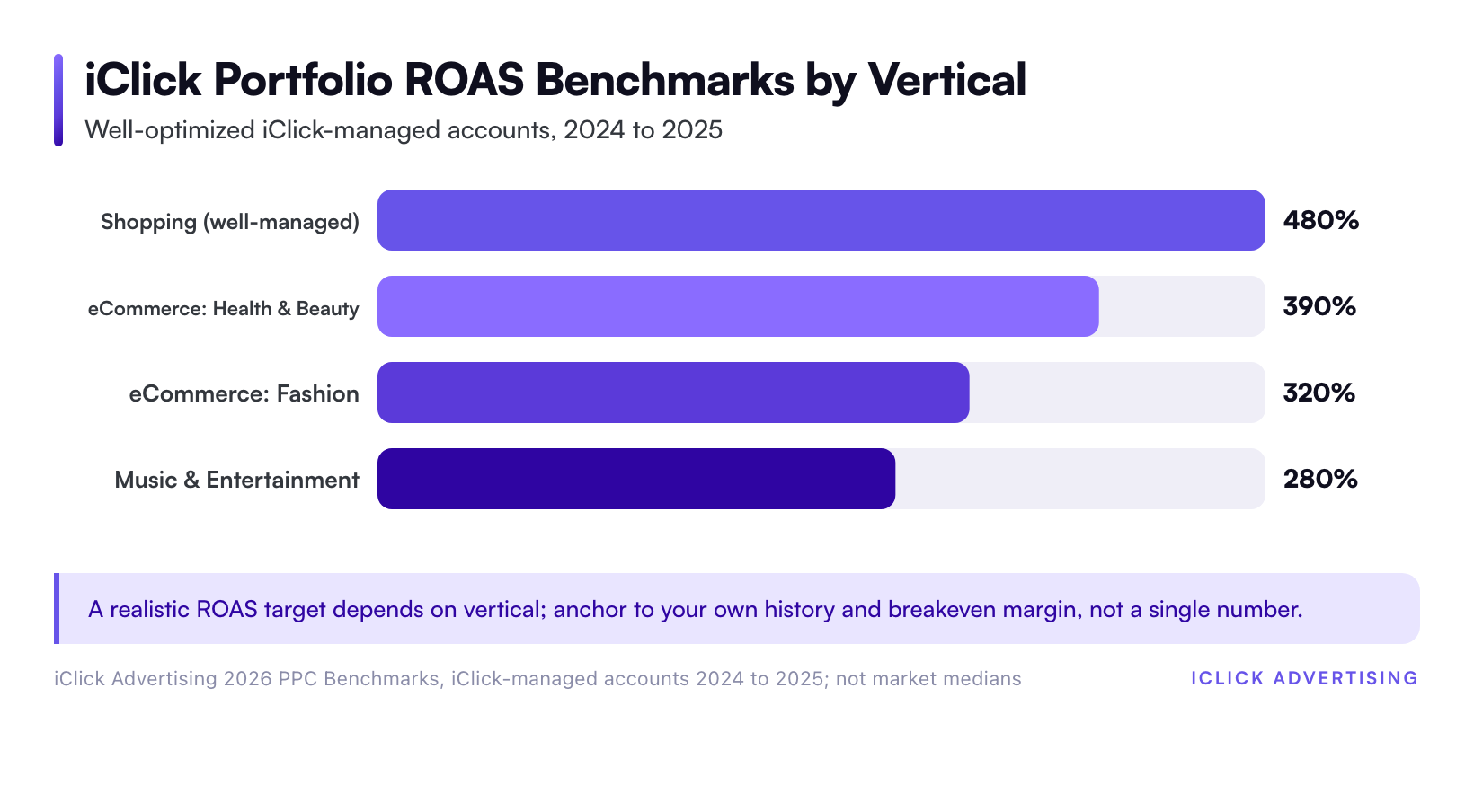
Once the campaign settles, move targets in small steps. Google recommends waiting one to two full conversion cycles before comparing target ROAS to actual ROAS. It also warns against making several ROAS changes inside one cycle.
Five mistakes that break value-based bidding
- Sending one static value. Google requires two or more different values. Identical values turn tROAS into a slower version of Target CPA.
- Counting micro-conversions as primary. Page views and add-to-carts set as primary goals inflate reported value and mislead the bidder.
- Double-counting purchases. A Google tag and a GA4 import firing on the same order doubles reported revenue. Your ROAS looks great while real returns fall.
- Changing targets every week. Each change lands inside a conversion cycle, and the bidder never gets a clean read.
- Ignoring feed health. Our benchmark data shows a 12% feed disapproval rate in unmanaged Shopping accounts. A disapproved product can’t earn value at any bid.
Where value-based bidding fits in the AI ads stack
Value-based bidding is the engine under Performance Max, AI Max for Search, Demand Gen, and Shopping. Each campaign type reads the same conversion values. Our breakdown of Google’s AI ads stack: AI Max, Performance Max, and Demand Gen covers how they overlap.
Overlap matters here. Our benchmark data shows Performance Max cannibalizes Shopping in 80%+ of accounts. When two campaigns bid on the same value signal, they compete with each other for the same buyer.
Meta runs the same logic under a different name. Its value optimization bids on purchase values sent through the Conversions API. Our guide to Meta’s Advantage+ and the Andromeda algorithm covers that setup.
None of this runs itself. The bidder is automated, but the inputs, values, and guardrails are not. That’s the honest answer to whether AI will replace PPC agencies. It’s also the core of our AI PPC management service.
Check your value signals before you scale
If your account bids on value but your values are flat, duplicated, or stale, Google is optimizing toward the wrong number. More budget only makes that mistake bigger.
Our free written audit is a 47-point PDF delivered in five business days, with no sales call. It checks your conversion setup, your values, and whether your bid strategy fits your data. Request your free written PPC audit.
Related on iClick
Sources
- Google Ads Help: About Smart Bidding using value-based bidding for Search and Shopping
- Google Ads Help: Value-based Bidding Best Practices (Citibanamex case)
- Google Ads: Increase your ROI with Value-based Bidding (October 2025; Google internal data, March 2021)
- Google Blog: Google Marketing Live 2026 bidding and budgeting news
- iClick Advertising: 2026 PPC Benchmarks (iClick portfolio data, 2024 to 2025)
- iClick Advertising: Client case studies
Frequently asked questions
What is the difference between value-based bidding and Target CPA?
Target CPA optimizes for the number of conversions at a set cost per conversion. Every conversion counts the same. Value-based bidding, through Maximize conversion value or Target ROAS, optimizes for total conversion value. It bids more for clicks likely to produce bigger orders or better leads. Google’s data shows a median 14% lift in conversion value after moving from Target CPA to Target ROAS.
How many conversions do you need for value-based bidding?
Google recommends at least 15 conversions in the last 30 days for Target ROAS, measured at the conversion tracking level. You also need two or more different conversion values. Accounts below that bar usually do better starting on Maximize conversion value or Maximize conversions. They can move to a ROAS target once volume and value data build up.
Can lead generation businesses use value-based bidding?
Yes. Lead-gen accounts use proxy values, such as a lead score or an expected fee based on close rates. Import offline conversions from a CRM like Salesforce or HubSpot so Google sees which leads became customers. Google’s help center cites Citibanamex, which saw a 27% increase in credit card bookings and a 7% lower cost per booked card.
How long does value-based bidding take to work?
Plan for five weeks or more before judging it. Google recommends uploading values for three weeks, or one to two conversion cycles, before activation. After you switch it on, allow a ramp-up period of at least two weeks. Then wait one to two full conversion cycles before comparing actual ROAS to your target, and avoid stacking changes inside one cycle.
Should I send revenue or profit as my conversion value?
Send profit if your margins vary widely by product. Revenue treats a $200 order at a 15% margin as worth more than a $120 order at a 60% margin, even though the second earns more. If you can’t pass profit, use conversion value rules to weight high-margin categories or new customers. Either way, avoid a single static value.