

TL;DR: You can buy ads in two AI chatbots today: ChatGPT (self-serve since May 2026) and Microsoft Copilot (through Microsoft Advertising). Google sells ads in AI Mode and AI Overviews, but not in the Gemini app. Perplexity dropped ads in 2026. Microsoft reports Copilot ads earn 73% higher click-through rates than standard search ads.
What AI chatbot advertising actually means
AI chatbot advertising is paid placement inside a conversational AI answer. The user asks a question. The assistant answers. A labeled sponsored unit appears next to, below, or inside that answer.
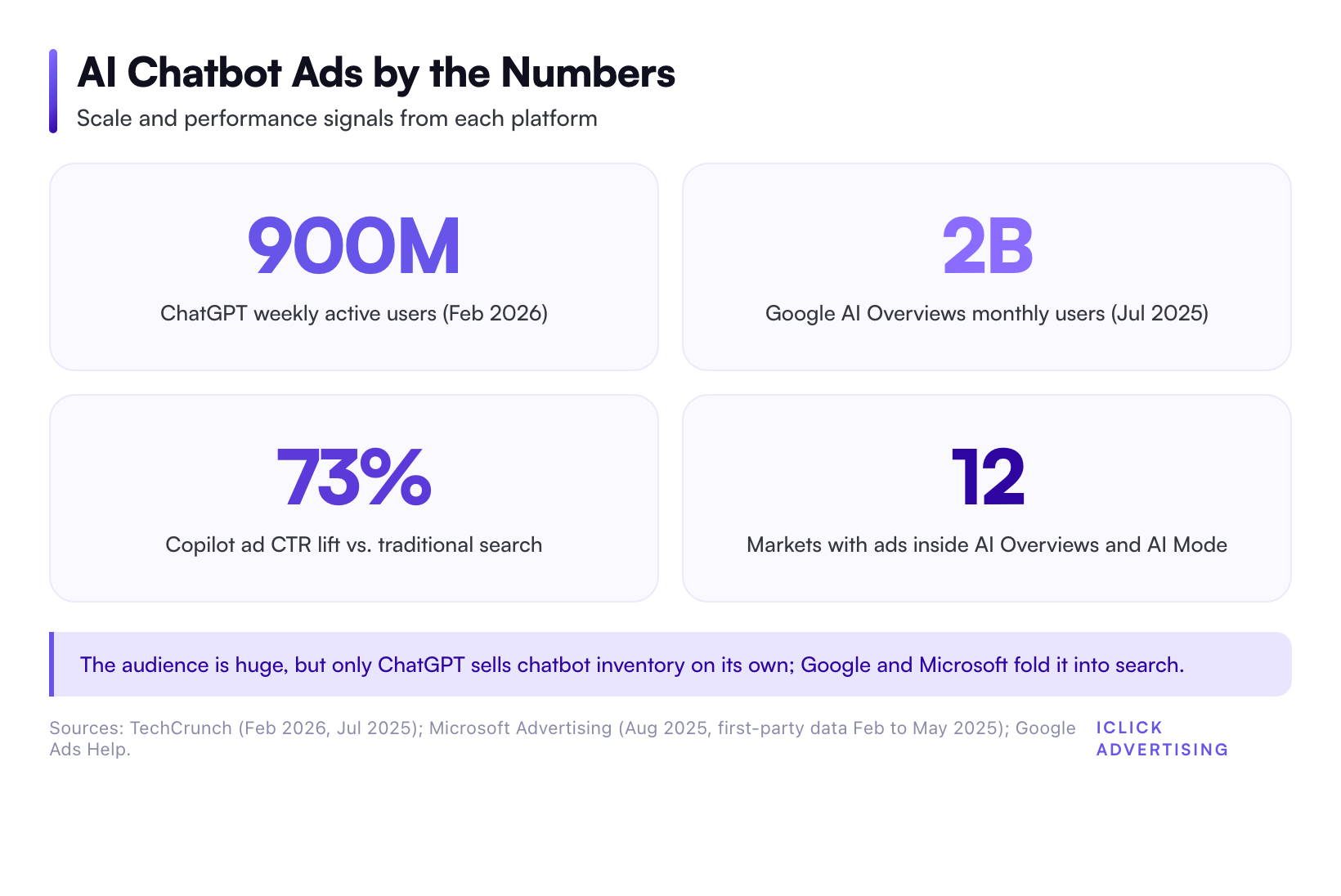
The audience is already large. TechCrunch reported on February 27, 2026, that ChatGPT had reached 900 million weekly active users. Alphabet said in July 2025 that AI Overviews had passed 2 billion monthly users.
But a big audience doesn’t mean there’s ad space to buy. Each of the four big assistants treats ads differently. One is fully self-serve. One folds ads into an existing search platform. One sells ads around its AI but not inside its app. One tried ads and quit.
This guide covers each one in four parts: availability, format, how to buy, and what is known versus unknown. For the wider strategy picture, start with our AI in PPC playbook.
The four platforms at a glance
| Platform | Ads live? | Format | How to buy | Biggest unknown |
|---|---|---|---|---|
| ChatGPT | Yes, Free and Go tiers | Labeled units below the answer | OpenAI Ads Manager (self-serve beta) | Conversion performance at scale |
| Microsoft Copilot | Yes | Text, Shopping, and multimedia ads inside answers | Microsoft Advertising campaigns, no separate opt-in | Copilot-only reporting depth |
| Perplexity | No, retired | Was sponsored follow-up questions | Not available | Whether ads ever return |
| Google AI Mode and AI Overviews | Yes, 12 markets | Search and Shopping ads in AI answers | Existing Search, Shopping, and Performance Max campaigns | Ads in the Gemini app itself |
ChatGPT: the only fully self-serve chatbot ad platform
Availability
OpenAI started testing ads in the U.S. on February 9, 2026. The test covered logged-in adults on the Free and Go tiers. Plus, Pro, Business, Enterprise, and Education users see no ads.
OpenAI then rolled ads to Australia, New Zealand, and Canada in April 2026, and to the UK in June 2026, per its release notes. Digiday reported that the UK became the fifth self-serve market.
Format
Ads sit at the bottom of an answer when a sponsored product matches the conversation. They are labeled and separated from the organic response. OpenAI says answers are generated independently of ads.
There are hard exclusions. During the test, OpenAI said ads would not appear in chats about health, mental health, or politics. They are also not shown to users OpenAI knows or predicts are under 18.
How to buy
OpenAI opened a self-serve Ads Manager in beta in May 2026. Digiday reported the earlier $50,000 minimum was dropped, which opened the platform to U.S. advertisers of all sizes.
Early inventory sold on a CPM basis only. CPC bidding came next. Digiday saw screenshots showing bids of $3 to $5 per click. A conversions API and a pixel launched alongside the manager.
Our ChatGPT ads explainer covers the format in depth. For pricing, read what a click inside ChatGPT really costs. For setup, follow our OpenAI Ads Manager walkthrough.
Known versus unknown
- Known: tiers, placement, sensitive-topic exclusions, CPM and CPC buying, and a first-party pixel.
- Unknown: independent conversion data. Digiday reported that third-party measurement was still pending at launch.
- Unknown: how ad matching weighs past chats. OpenAI says it matches ads to the current topic, past chats, and past ad interactions, but publishes no weighting.
Microsoft Copilot: the easiest chatbot inventory to reach
Availability
Copilot has carried ads longer than any other major assistant. They come from the Microsoft Advertising network, the same auction that powers Bing search ads. Our Copilot ads guide covers formats, eligibility and setup in detail.
Format
Copilot ads adapt to what the user types. Microsoft pulls from text ads, feed-based Shopping ads, and multimedia ads in your existing campaigns.
Microsoft published performance numbers in August 2025. Using its own data from February to May 2025, it reported Copilot ads drove 73% higher click-through rates and 16% stronger conversion rates than traditional search. It also reported customer journeys 33% shorter.
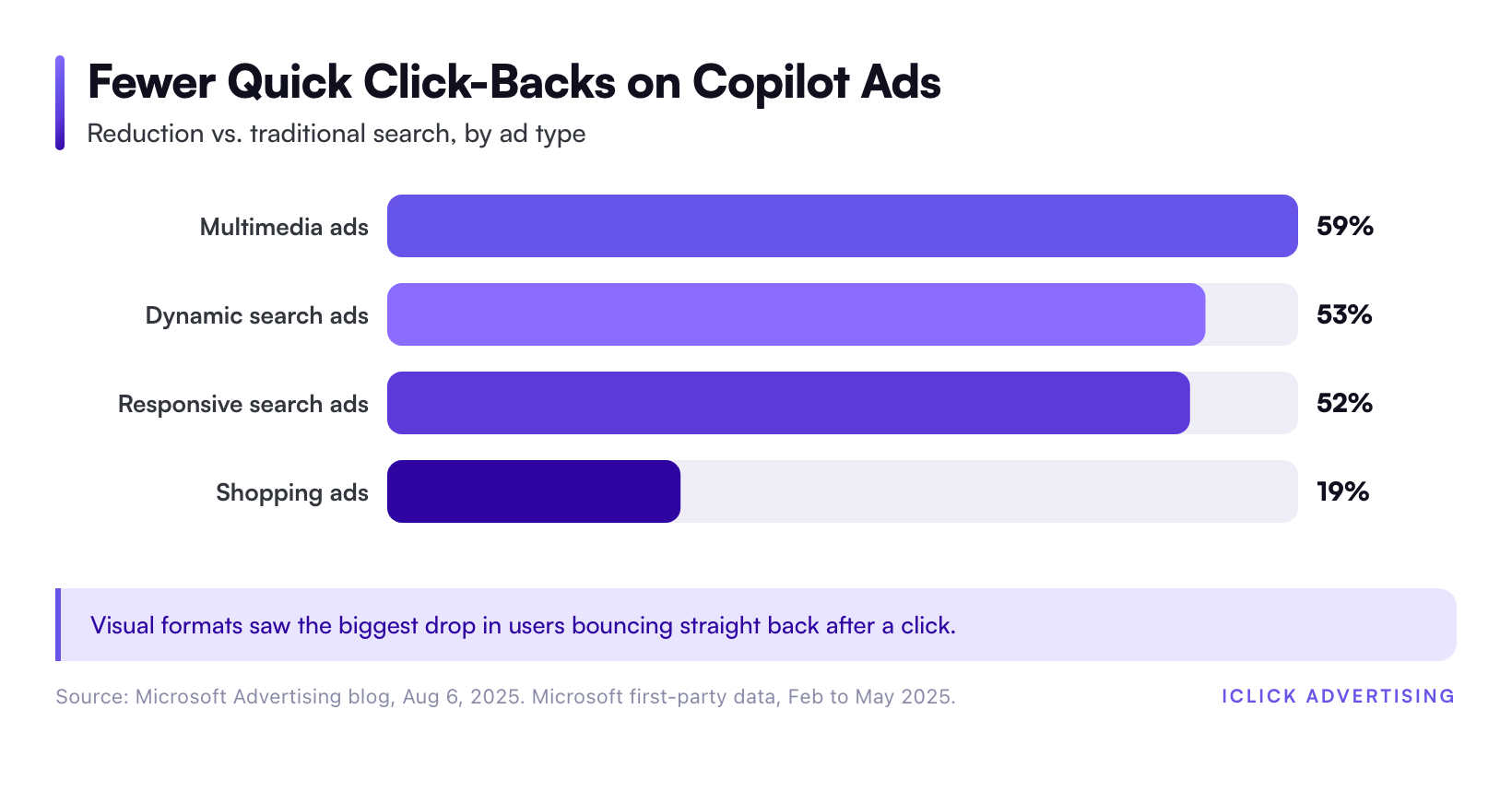
The same post reported fewer quick click-backs, meaning fewer users bouncing straight back after a click. Multimedia ads in Copilot had 59% fewer quick-backs. Shopping ads had 19% fewer.
How to buy
There is no Copilot campaign type. Search Engine Land reports that Performance Max, AI Max, Search campaigns on exact, phrase, and broad match, multimedia ads, and Shopping ads are all eligible.
Microsoft has called Performance Max the best route into Copilot. It gives the system the most room to match products to intent. Our Microsoft Copilot advertising guide walks through the setup.
Known versus unknown
- Known: eligible campaign types, and Microsoft’s own lift figures.
- Unknown: independent verification. The 73% figure is Microsoft first-party data, not an audited study.
- Unknown: how cleanly you can isolate Copilot spend from Bing search spend in reporting.
Perplexity: ads launched, then shut down
Availability
None today. Perplexity began testing ads in the U.S. on November 12, 2024. Launch partners included Indeed and Whole Foods Market.
The program did not last. AdExchanger reported that Perplexity stopped taking new advertisers in October 2025. In February 2026, the Financial Times reported Perplexity had removed its sponsored placements with no plans to bring them back, per Search Engine Land.
Format
The format was sponsored follow-up questions, plus paid media beside an answer. Perplexity wrote the answers to those sponsored questions itself. Brands did not write or edit them.
How to buy
You can’t. Adweek, citing The Information, reported that ads brought in about $20,000 against $34 million in revenue. Executives later argued labeled ads could erode trust in AI answers.
Known versus unknown
- Known: the format, the launch date, and the wind-down.
- Unknown: whether ads return. Some reports say executives left the door open.
The takeaway for planners is simple. Any guide still selling Perplexity Sponsored Questions is describing a retired product.
Google Gemini, AI Mode, and AI Overviews: ads around the AI, not in the app
Availability
Google splits this into two surfaces. Ads run inside AI Overviews and AI Mode in Google Search. The standalone Gemini app has no ads.
On December 8, 2025, Google VP of Global Ads Dan Taylor said there are no ads in the Gemini app and no current plans to change that. Google repeated the position in January 2026, per 9to5Google. Note the wording: “no current plans” is not “never.”
On October 28, 2026, Google said it was scaling ads in AI Mode to 10 new countries, including Australia, Canada, and India. It plans Brazil, Mexico, and the UK in Q4 2026. It also launched multiturn ads in the U.S., which can show in follow-up queries.
Format
Standard Search and Shopping ads can show within AI answers. At Google Marketing Live on May 20, 2026, Google announced tests of new formats. Conversational Discovery ads answer a specific question with Gemini-built creative. Highlighted Answers place a relevant ad inside an AI Mode list.
Google also runs a Direct Offers pilot, launched in January 2026. Google named Chewy, Gap, and L’Oreal as participants.
How to buy
Google Ads Help says existing Search, Shopping, and Performance Max campaigns are automatically eligible. No new campaign or budget is needed. Broad match and AI Max for Search qualify for both contextual and direct query matching.
Exact and phrase match only qualify when the query shows direct commercial intent. Our breakdown of Google’s AI ads stack: AI Max, Performance Max, and Demand Gen explains how those campaign types interact.
Known versus unknown
- Known: eligible campaign types, English-language markets, and standard auction pricing with no surcharge.
- Known limit: Google says you can’t target AI Overviews or AI Mode exclusively, or opt out of them separately from Search. Negative keywords and brand exclusions still apply.
- Known limit: you can’t write, edit, approve, or opt out of the AI explainers Google pairs with ads.
- Unknown: when, or whether, Gemini app ads arrive.
Why chatbot ads behave differently from search ads
A search query is short. A chatbot conversation is long, and it carries context from earlier turns. That changes how ads are matched.
OpenAI matches ads to the conversation topic, past chats, and past ad interactions. Google now serves multiturn ads in AI Mode follow-up queries in the U.S. In both cases, the trigger is closer to a conversation than to a keyword.
That has three practical effects.
- Keywords matter less. Google says exact and phrase match only qualify for AI answers with direct commercial intent. Broad match and AI Max reach the exploratory questions.
- Creative is partly out of your hands. Google’s Conversational Discovery ads use Gemini-built creative, and you can’t edit the AI explainers paired with ads.
- Exclusions are broader. ChatGPT blocks ads in health, mental health, and politics chats. Advertisers in those categories have no ChatGPT inventory today.
Plan for less control over placement. Lean harder on landing pages, product feeds, and conversion tracking.
How to decide where to test first
Start from the campaigns you already run. Two of the three live platforms need no new campaign at all.
- Running Google Search, Shopping, or Performance Max? You are probably already eligible for AI Overviews and AI Mode. Audit your search terms and negatives first.
- Running Microsoft Advertising? Copilot is likely already in your mix. A Performance Max campaign widens eligibility.
- Want a clean test? ChatGPT is the only platform where chatbot inventory is bought on its own. That makes it the cleanest read on incremental value, and the riskiest budget line.
Keep the ChatGPT test small and capped. With CPC bids reported at $3 to $5, a 1,000-click test runs $3,000 to $5,000 before any conversion tracking is proven.
Watch the measurement gaps. No platform here offers fully independent, audited conversion data for chatbot placements yet. Treat early platform-reported lift as a hypothesis, not proof.
What this means for your existing accounts
Chatbot ads are not a separate channel for most advertisers yet. On Google and Microsoft, they are an extension of search. That means search fundamentals decide whether you show up: clean feeds, tight negatives, and strong landing pages.
Social platforms are moving the same way. Meta folds AI into delivery rather than chat placements. Our guide to Meta’s AI ads stack covers that side.
None of this removes the need for human judgment. Someone still has to set budgets, kill weak tests, and read the data honestly. We make that case in Will AI replace PPC agencies? An agency’s honest answer. If you want help running these tests, see our AI PPC management service.
Get a written read on your AI ad readiness
Before you fund a ChatGPT test, check whether your Google and Microsoft campaigns are already serving in AI answers, and whether they deserve to. Our free written PPC audit is a 47-point PDF delivered in five business days, with no sales call. It flags feed, match type, and negative keyword gaps that decide where your ads show in AI search.
Related on iClick
Sources
- TechCrunch: ChatGPT reaches 900M weekly active users (Feb 27, 2026)
- TechCrunch: Google’s AI Overviews have 2B monthly users (Jul 23, 2025)
- OpenAI: Testing ads in ChatGPT
- TechCrunch: ChatGPT rolls out ads (Feb 9, 2026)
- OpenAI: ChatGPT release notes
- Digiday: OpenAI opens up ChatGPT ads manager to the U.S.
- Digiday: OpenAI turns on cost-per-click ads inside ChatGPT
- Digiday: OpenAI expands ads manager to U.K., adds CPC
- Adweek: OpenAI opens ChatGPT ads to self-service platform
- Microsoft Advertising: 73% higher CTRs (Aug 6, 2025)
- Microsoft Advertising: How generative AI is reshaping search, Q&A
- Search Engine Land: How to get the most from Microsoft Advertising campaigns
- Perplexity: Why we’re experimenting with advertising (Nov 12, 2024)
- Search Engine Land: Perplexity stops testing advertising
- AdExchanger: Perplexity says ads erode trust in AI (Feb 20, 2026)
- Adweek: Perplexity pauses new advertising deals
- 9to5Google: Google says no ads in Gemini (Dec 8, 2025)
- 9to5Google: Google reiterates Gemini won’t have ads (Jan 21, 2026)
- Google Ads Help: About ads in AI-powered experiences in Google Search
- Google: Ads in AI Mode expand to 10 new countries (Oct 28, 2026)
- Google Marketing Live 2026: A new generation of ads for the AI era of Search (May 20, 2026)
Frequently asked questions
Which AI chatbots can I advertise in right now?
ChatGPT and Microsoft Copilot both sell ads today. ChatGPT uses OpenAI’s self-serve Ads Manager. Copilot ads run through Microsoft Advertising campaigns. Google sells ads inside AI Overviews and AI Mode in Search, but not in the Gemini app. Perplexity removed its ads in early 2026.
Do I need a new campaign to show ads in Google AI Mode?
No. Google Ads Help says existing Search, Shopping, and Performance Max campaigns are automatically eligible for AI Overviews and AI Mode. You can’t target those surfaces exclusively or opt out of them separately from Search. Negative keywords and brand exclusions still control where your ads appear.
Are there ads in the Gemini app?
No. On December 8, 2025, Google VP of Global Ads Dan Taylor said there are no ads in the Gemini app and no current plans to change that. Google repeated that position in January 2026. Ads do run in AI Overviews and AI Mode, which are part of Google Search.
How much do ChatGPT ad clicks cost?
Digiday reported, based on Ads Manager screenshots, that advertisers could set CPC bids of $3 to $5. Before CPC launched, ChatGPT inventory sold only on a CPM basis. OpenAI also dropped its earlier $50,000 minimum when it opened self-serve buying to U.S. advertisers.
Are Microsoft’s Copilot ad performance numbers reliable?
They are Microsoft’s own first-party data from February to May 2025, not an independent study. Microsoft reported 73% higher click-through rates and 16% stronger conversion rates versus traditional search. Treat them as a reason to test, then judge Copilot on your own conversion tracking.